
Students Offered an AI Tutor Got Lower Grades, a Large Trial Finds
Universities are racing to give students AI study tools. A randomised trial at the University of Maryland — one of the largest of its kind, published as a working paper in October 2026 — suggests that simply switching one on can backfire. Students in course sections given an AI tutor engaged less with their courses, and in sections of the same course they ended up with lower final grades. The tool itself wasn't necessarily the problem. How it was introduced, and how students used it, may have been.
- The trial covered 2,379 undergraduates and 30 instructors across 34 course sections and many disciplines in fall 2025. Instructors were randomly assigned to switch the AI tutor on or off [1].
- In sections of the same course, being offered the tutor lowered final grades by about 4 points out of 100 (0.37 standard deviations) [1].
- Participation in online course activities fell sharply (0.90 standard deviations), and survey responses pointed to fewer contacts with instructors [1].
- Only about 15% of students offered the tutor used it, and most requests were for answers rather than practice or feedback [1].
- The researchers say the results don't show AI tutors can't help — other trials of carefully designed tutors have found gains. Design and integration matter [1, 4, 5].
What the trial tested
The tool was a "Virtual Study Assistant" built on OpenAI's GPT-4o and embedded in the university's learning management system. It used retrieval-augmented generation to answer from course materials chosen by each instructor, and instructors could switch it between a tutoring mode, which guides students towards an answer, and a direct instruction mode, which gives more explicit explanations [1].
The study ran during the fall 2025 semester. Instructors teaching the same or similar courses were grouped, and within each group they were randomly assigned to have the tutor switched on or off for all their students. The courses spanned 11 of the university's 12 schools and colleges, including biology, computer science, English, mathematics and public policy [1]. The authors registered their analysis plan in advance.
2,379
undergraduates, taught by 30 instructors in 34 course sections [1]
−4 points
lower final grades out of 100 in same-course sections (0.37 SD) [1]
~15%
of students offered the tutor actually used it [1]
What happened
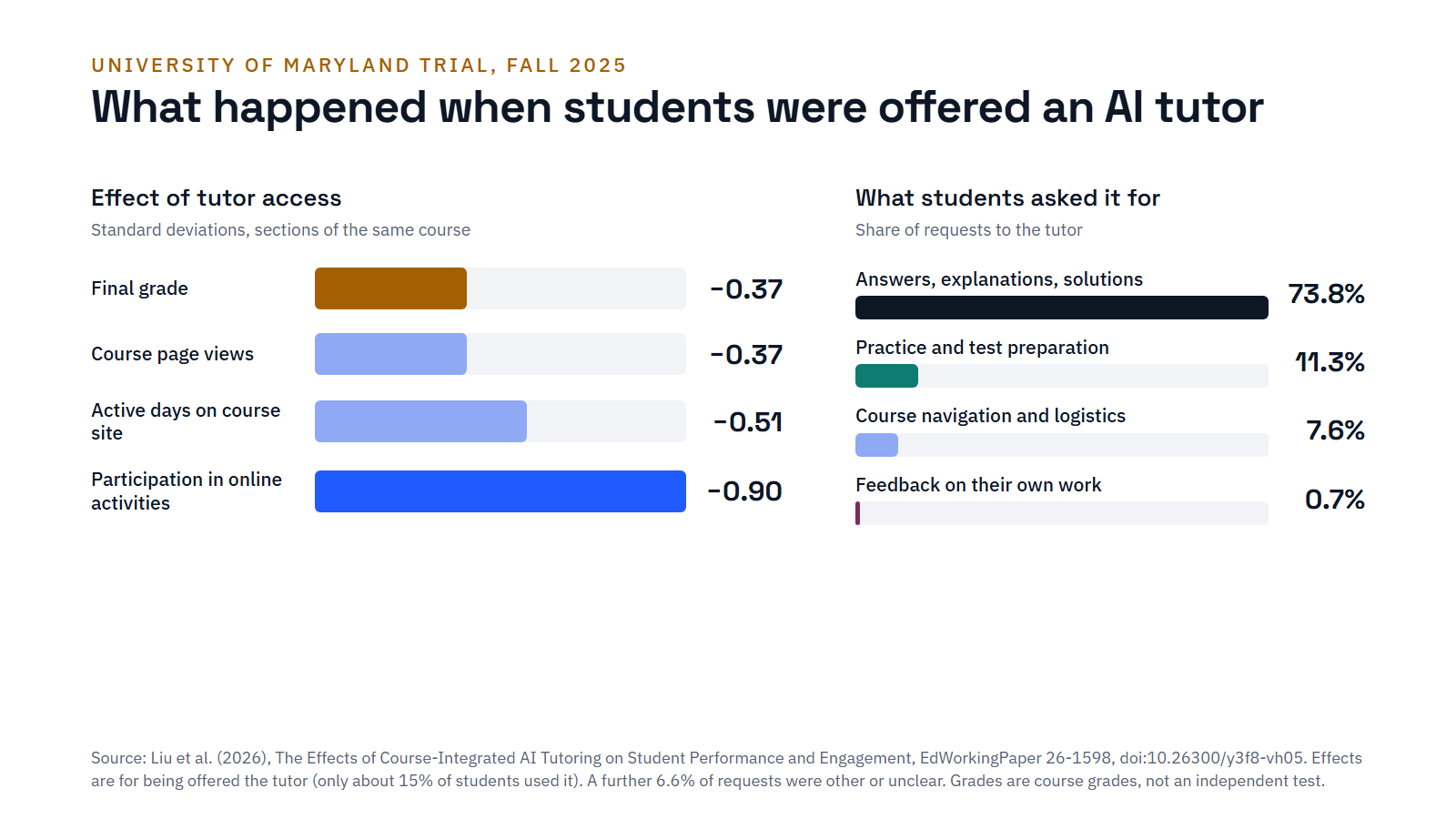
The clearest effects were on behaviour. In sections of the same course, students offered the tutor viewed fewer course pages (−0.37 standard deviations), were active on the course site on fewer days (−0.51) and took part in far fewer instructor-designed online activities, such as discussions and quizzes (−0.90). The reductions were similar across the whole sample [1].
Grades told a more mixed story. Across the full sample, which compared similar but not identical courses, there was no statistically significant effect on grades. But in the cleaner comparison — sections of the same course — final grades were 4.12 points lower out of 100, and letter grades were 0.11 grade points lower on a 4-point scale. Homework scores showed no clear effect [1].
First-generation college students appeared to be hit harder. Their estimated losses in final grades were more than twice those of their peers in both samples — for example, −5.10 points versus −2.23 points in the full sample — though the researchers note that statistical precision varies [1].
Why might an AI tutor lower grades?
The researchers analysed what students asked for. About 73.8% of requests sought information, explanations or solutions; 11.3% involved practice or test preparation; and just 0.7% asked for feedback on the student's own work. Use was episodic and spiked around exams. Most instructors left the tool in its default direct-instruction mode, and none of the instructors who answered the survey said they had built it into assignments [1].
A surprising detail: in same-course sections, lower grades were not confined to students who used the tutor — non-users in those classes did similarly. Because students already had access to tools like ChatGPT and Gemini, the authors suggest that introducing the tutor may have changed the wider classroom culture around AI, for example by making AI use feel more acceptable, rather than the effect coming only from the tutor itself [1].
Students mostly used the AI tutor as an answer machine, and classes that had it engaged less with the course. Getting answers quickly can feel productive, but the effort of attempting, getting feedback and trying again is where much of the learning happens.
The limits of the study
- Course grades, not an independent test. Grading can differ between sections, which makes it harder to measure learning precisely [1].
- Effects of access, not use. With only about 15% of students using the tutor, the results describe what happened when it was offered — which may include wider changes in AI use [1].
- Platform data is partial. Activity on the course website captures only part of how students study [1].
- Low survey response. Just 18% of students answered the end-of-term survey [1].
- A working paper. The study has not yet been through peer review, and it covers one university.
How it fits with other research
The results echo some studies and contrast with others. The difference often comes down to design:
Lower grades
A general study assistant added to courses, mostly in answer mode, with little instructional integration [1].
Harm without guardrails
Students with a standard ChatGPT-style tool did 48% better in practice but 17% worse on exams once it was removed. A version with built-in tutoring safeguards largely avoided the harm [4].
Better learning
An AI tutor designed around proven teaching principles helped students learn significantly more in less time than an in-class active learning session [5].
Grounding the tutor in course materials "may improve the relevance of AI assistance, but it does not ensure productive use." — the study's authors [1]
What to watch
- Follow-up research. The lead author, Jing Liu, has said a second paper from a separate study is due soon [3].
- Peer review. Whether the findings hold up through journal review.
- Better-designed deployments. Trials where instructors are trained and tutors are built into assignments, with a tutoring mode by default.
- Equity. Whether the larger losses for first-generation students appear elsewhere.
Lessons for universities and training providers
- Don't just switch it on. Access alone isn't a teaching strategy; build the tool into learning activities.
- Default to tutoring, not answers. Settings that prompt students to attempt, explain and revise are more likely to support learning [1, 4].
- Train instructors. The authors suggest results might have differed with more extensive instructor training [1].
- Measure engagement as well as grades. Falling participation can be an early warning sign.
- Watch for unequal effects. Check outcomes for different student groups, not just averages.
- Run trials before scaling. Randomised pilots like this one show what actually happens in real classes.
Sources
Every figure in this article comes from the sources below.
- Liu, J., Sweet, T., Chen, M. H., Engelberg, J., Masters, M., Clark, M., Persaud, A., Lancaster, A., Hollingsworth, J. and King Rice, J. (2026). The Effects of Course-Integrated AI Tutoring on Student Performance and Engagement: A Randomized University Trial. EdWorkingPaper 26-1598, Annenberg Institute at Brown University. doi:10.26300/y3f8-vh05.
- University of Maryland, College of Education. Publication summary.
- EdTech Innovation Hub (October 2026). Students offered an AI tutor got lower grades and disengaged from course materials.
- Bastani, H. et al. (2025). Generative AI without guardrails can harm learning: Evidence from high school mathematics. PNAS 122(26). Summary.
- Kestin, G. et al. (2025). AI tutoring outperforms in-class active learning. Scientific Reports 15, 17458.