
Robots in Hospitals: Beyond the Operating Theatre
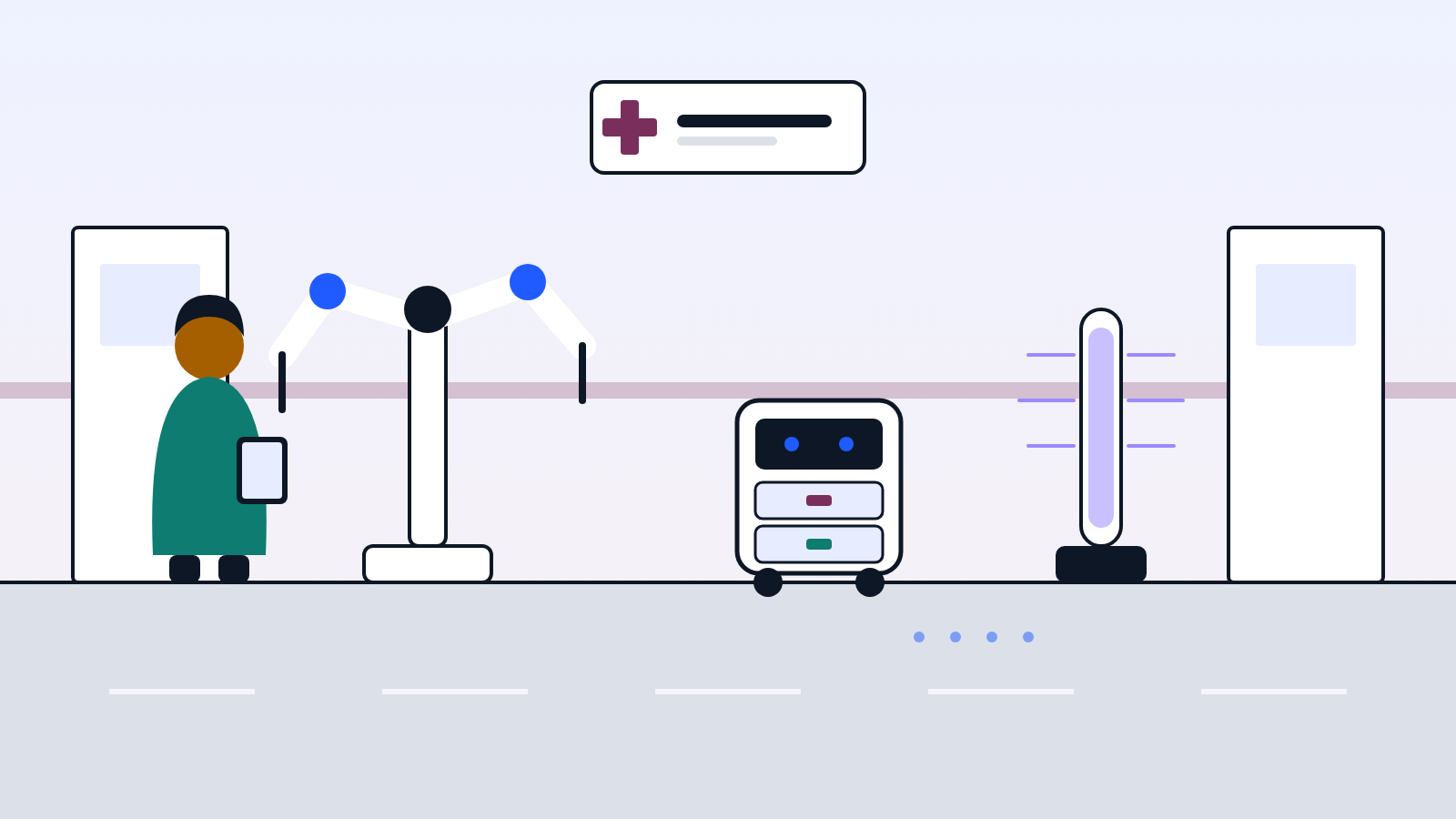
When people think of robots in hospitals, they usually picture a surgeon at a console guiding robotic arms. Surgical robots are booming — but they're only part of the story. Robots now carry medicines and lab samples along corridors, prepare drugs in pharmacies, disinfect rooms, help patients relearn to walk and run laboratory tests. Here's where hospital robots are being used, what the evidence really shows, and what hospitals should consider before bringing them in.
- Robotic surgery is growing fast: more than 3.1 million operations used da Vinci robots in 2025, up 18%.
- Sales of surgical robots rose 57% in 2025, making them the main driver of medical robotics growth.
- Outside surgery, robots deliver supplies, dispense medicines, disinfect rooms, support rehabilitation and automate lab work.
- Staff shortages are a key reason hospitals are interested, but peer-reviewed evidence on many non-surgical robots is still limited.
- Success depends on choosing the right tasks, integrating robots with hospital systems and involving staff from the start.
Surgery: still the flagship
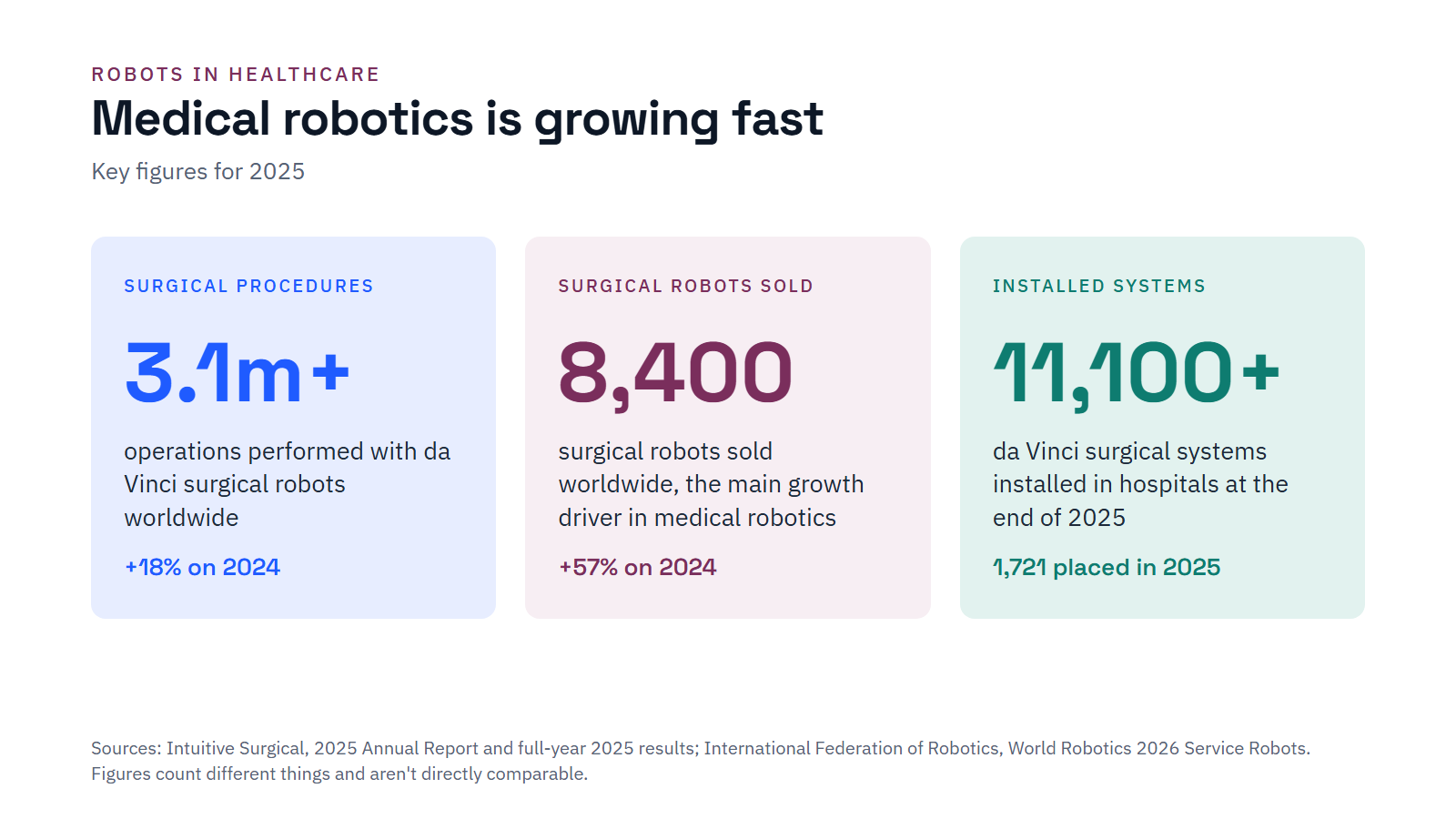
Surgical robots remain the most visible and valuable part of medical robotics. Intuitive Surgical, the maker of the da Vinci system, reported that more than 3.1 million procedures used its robots in 2025, an 18% increase, with over 11,100 da Vinci systems installed worldwide [1]. The International Federation of Robotics counted 8,400 surgical robots sold in 2025, up 57% — the key growth driver in medical robotics [2].
A surgical robot does not operate on its own. The surgeon sits at a console and controls robotic arms that hold the instruments and a camera. The robot filters out hand tremor and allows very precise movements through small incisions.
Studies comparing robotic surgery with standard keyhole surgery show mixed results: benefits vary by procedure and by surgeon experience, and robots add significant cost. The technology is most established in urology, gynaecology and general surgery.
Beyond the operating theatre
Robots are taking on a growing range of jobs elsewhere in hospitals. The IFR reported that in 2024, sales of rehabilitation and non-invasive therapy robots rose 106%, and robots for diagnostics and medical laboratory analysis increased by 610% [3].
Delivery robots
Carry medicines, lab samples, linen and meals along corridors and in lifts, so nurses and porters walk less.
Dispensing and compounding
Pick and pack medicines, and prepare doses such as intravenous chemotherapy in sterile, precisely measured conditions.
Disinfection
UV-C light robots disinfect empty rooms and theatres between patients, alongside manual cleaning.
Therapy and exoskeletons
Help patients recovering from strokes or spinal injuries practise walking and arm movements with repeatable support.
Lab automation
Sort, test and store thousands of samples a day, speeding up results and reducing handling errors.
Telepresence
Let specialists "visit" wards remotely, and help patients in isolation stay in touch with family.
Why hospitals are interested
- Staff shortages. The WHO projects a global shortfall of 11.1 million health workers by 2030 (see How AI Could Change Healthcare Delivery).
- Time on non-clinical tasks. Nurses spend significant time fetching supplies and carrying samples — work robots can take on.
- Safety and consistency. Robots can measure drug doses precisely and disinfect rooms the same way every time.
- Physical strain. Lifting and moving heavy loads causes injuries among hospital staff.
What the evidence says
Evidence for non-surgical hospital robots is still thinner than the marketing suggests. A 2024 systematic review in Frontiers in Robotics and AI examined 28 studies of robots designed to work with nurses. It found few were explicitly designed to reduce nursing workload, and the authors could not find peer-reviewed evidence on the effectiveness of some widely deployed hospital delivery robots [4].
Early studies are encouraging but limited. One time-and-motion study in a Taiwanese intensive care unit, presented as a conference abstract, found a delivery robot cut nurses' daily logistics time from about 111 minutes to about 20 — though at a cost per nursing hour saved that exceeded local nurse wages [5].
Robots can give nurses time back. The question is whether that time costs less than hiring help — and whether it ends up with patients.
The challenges
- Cost. Surgical robots cost millions, plus maintenance and instruments; even delivery robots require significant investment.
- Integration. Robots need to work with lifts, doors, networks and hospital IT systems.
- Infection control. Robots moving between wards must themselves be kept clean.
- Cybersecurity. Connected robots are part of the hospital network and must be protected.
- Trust. Staff and patients need to understand what robots do and feel confident working alongside them.
Getting it right
- Start with a clear problem — such as delayed lab results or long walks to the pharmacy — and measure it before and after.
- Involve nurses, porters and pharmacists in choosing and testing robots.
- Run a pilot on one ward or route before rolling out widely.
- Plan the time saved: decide how freed-up staff time will be used for patient care.
- Check safety and data protection, including cybersecurity and infection control procedures.
What to watch next
- Robotic surgery in more specialties, and new competitors driving prices down.
- Independent studies of delivery and nursing-assistant robots.
- Robots supporting care at home — see Remote Monitoring and the Hospital at Home.
- AI-guided robots that adapt to busy, unpredictable hospital environments.
- Regulation and standards for robots working alongside patients and staff.
Sources
Every figure in this article comes from the sources below.
- Intuitive Surgical (2026). 2025 Annual Report and full-year 2025 results.
- International Federation of Robotics (2026). "Global Sales of Professional Service Robots Surge 24%." World Robotics 2026 — Service Robots.
- International Federation of Robotics (2025). "Service Robots See Global Growth Boom." World Robotics 2025 — Service Robots.
- "A systematic review of collaborative robots for nurses: where are we now, and where is the evidence?" (2024). Frontiers in Robotics and AI. DOI: 10.3389/frobt.2024.1398140.
- "Cost-effectiveness of an automated delivery robot program to reduce nursing transport burden in an intensive care unit." ISPOR 2026 conference abstract.