The NHS Is Giving 505,000 Staff an AI Assistant. How Strong Is the Evidence?
Posted in :

The NHS Is Giving 505,000 Staff an AI Assistant. How Strong Is the Evidence?
NHS England is rolling out Microsoft 365 Copilot to more than half a million clinicians and support staff — described as the largest deployment of its kind in healthcare. The decision followed a large trial that reported staff saving 43 minutes a day. But reporting based on a Freedom of Information request has raised questions about how that figure was produced, and two other UK government trials of the same tool found much smaller savings. Here's what has been announced, what the evidence shows, and what other organisations can learn.
- In June 2026, NHS England announced Microsoft 365 Copilot for 505,000 clinicians and support staff, with 200,000 users planned in the first six months and the rest within a year.
- The decision followed a 2025 trial with more than 30,000 staff in 90 NHS organisations, which reported an average saving of 43 minutes per person per day.
- Reporting based on a Freedom of Information request says that figure came from self-selected case studies and staff estimates, not measurement. The full methodology has not been published.
- Other UK trials of the same tool found smaller savings: 26 minutes a day across government, and around 60 minutes a week in a randomised trial at HMRC.
- Even modest savings could add up across half a million staff. The real test will be independent evaluation of the rollout.
What NHS England announced
On 7 June 2026, NHS England and Microsoft announced that Microsoft 365 Copilot would be made available to 505,000 NHS clinicians and support staff. The agreement also gives NHS England access to Copilot Studio, Microsoft's tool for building AI agents, governed through Microsoft's Agent 365. The plan is to onboard 200,000 users within the first six months and complete the rollout over 12 months, alongside a training programme for all staff [1].
The announcement highlighted administrative uses: ward clerks managing discharges, rotas and bed management; medical secretaries producing minutes and templates; teams in HR, finance and procurement; and managers preparing board papers and briefings. NHS England also plans central AI agents to ease help desk workload and speed up complaints, Freedom of Information requests and financial processing [1].
505,000
clinicians and support staff to get Microsoft 365 Copilot [1]
200,000
users planned within the first six months [1]
30,000+
staff in 90 NHS organisations took part in the earlier trial [2]
The trial behind the decision
The rollout builds on a trial announced by the Department of Health and Social Care and NHS England on 21 October 2025. More than 30,000 NHS staff in 90 organisations used Copilot, and the government reported an average saving of 43 minutes per staff member per day — about five weeks a year — calling the results "unprecedented". It projected that a full rollout could save up to 400,000 hours of staff time a month, including 83,333 hours of note-taking in Teams meetings and 271,000 hours from summarising email chains [2].
The October 2025 announcement did not describe how the time savings were measured, and most of its larger figures were framed as projections of what "could" be saved [2].
Questions about the 43 minutes
In September 2026, the technology site Office Watch reported on a Freedom of Information request first covered by Private Eye. According to that reporting, the 43-minute figure was based on 86 case studies that participating organisations nominated as success stories; time savings were estimated by staff rather than measured; and the evaluation report was produced by Accenture, a major Microsoft partner. The same report reportedly also contained lower figures, including 33 minutes a day and 4 hours a month [3].
We have not seen the FOI documents ourselves, and Office Watch did not report a response from NHS England or Microsoft. But the concerns are significant enough that the trial's full methodology should be published.
When people choose their own success stories and estimate their own time savings, results tend to be optimistic. That doesn't mean the tool doesn't help — it means the size of the benefit is uncertain until it's measured more carefully.
How other UK trials compare
Two other large UK public-sector trials of Microsoft 365 Copilot published their methods in detail — and found smaller savings:
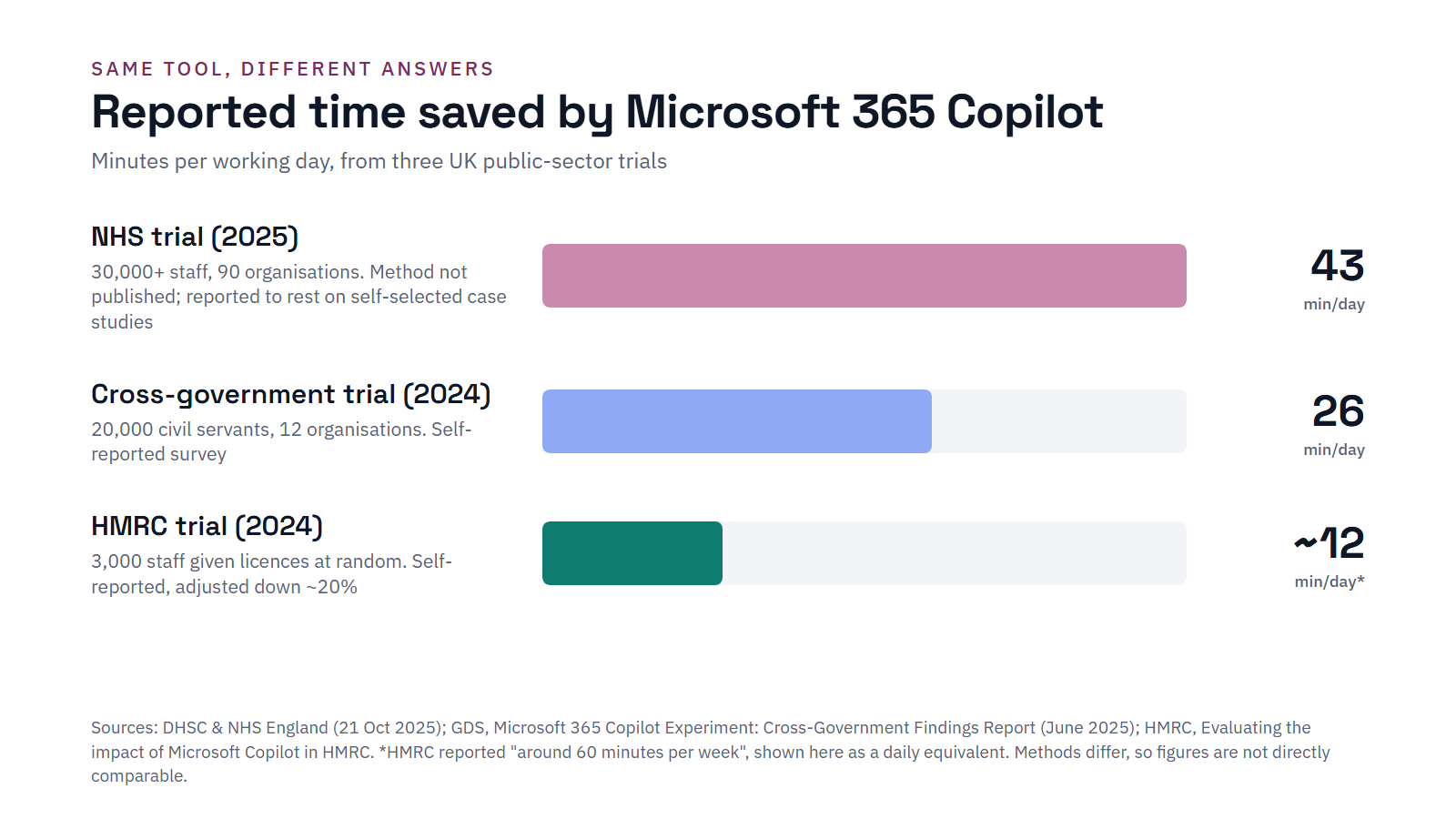
43 minutes a day
30,000+ staff in 90 organisations. Methodology not published; reported to rest on self-selected case studies and staff estimates [2, 3].
26 minutes a day
20,000 civil servants in 12 organisations. Self-reported survey with 7,115 responses; 17% noticed no clear time savings [4].
About 60 minutes a week
3,000 staff given licences at random. Self-reported savings of 2–3% of the working week, reduced by about 20% to correct for bias [5].
Same tool, same country, similar kinds of work — and estimates ranging from about 12 to 43 minutes a day. How you measure matters as much as what you measure.
Why the rollout could still matter
Even the most cautious estimate is not nothing. HMRC's randomised trial described its result as "a baseline estimate rather than a precise measure", and most HMRC users said they reinvested saved time in their regular work, work quality and wellbeing [5]. As a simple illustration, if every one of the 505,000 licensed NHS staff saved an hour a week, that would add up to around half a million hours a week — though real-world uptake is never universal.
The trials also agree on the conditions for success: staff need practical training and time to learn the tool, AI output needs human checking, and benefits vary by role and by how familiar people are with AI [4, 5].
What to watch
- An independent evaluation of the rollout, with a published method and comparison groups.
- Where the time goes. Whether hours saved on admin turn into more time with patients.
- Cost and value. The value of the NHS contract has not been officially published.
- Data and safety. How patient information is protected, and how AI agents built in Copilot Studio are governed.
- Uptake. Whether NHS England meets its target of 200,000 users in six months.
Lessons for other organisations
- Measure, don't just ask. Use comparison groups and usage data, not only surveys and success stories.
- Publish the method. Transparent evaluation builds trust in the results — and in the decision.
- Expect variation. Benefits differ by job, so target the roles with the heaviest admin load first.
- Plan for the time saved. Decide in advance how freed-up hours should be used.
- Invest in training. Every trial found that users with more support and AI familiarity benefited more.
Sources
Every figure in this article comes from the sources below.
- Microsoft (7–8 June 2026). NHS England accelerates AI adoption with Microsoft 365 Copilot. Press release.
- Department of Health and Social Care and NHS England (21 October 2025). Major NHS AI trial delivers unprecedented time and cost savings. Press release.
- Office Watch (2 September 2026). Copilot saves "43 minutes a day"? The real number is 12, citing Private Eye issue 1682.
- Government Digital Service (June 2025). Microsoft 365 Copilot Experiment: Cross-Government Findings Report.
- HM Revenue & Customs. Evaluating the impact of Microsoft Copilot in HMRC (Phase III trial, September–December 2024).