
Digital Twins: Moving Beyond the 3D Hype
Few technologies are as hyped as the digital twin. In vendor presentations, it's a gleaming 3D replica of a jet engine or factory that executives tour with VR headsets. But a 3D model on its own isn't a digital twin. A real twin is a live software copy of a physical machine or system — fed by sensors, kept in sync in real time, and able to act on what it learns. This guide cuts through the hype: what a digital twin really is, how it's built, where it's paying off, and how to start.
- A true digital twin is defined by live, two-way data, not by 3D graphics.
- It can estimate things sensors can't measure directly — like stress inside a turbine blade — and warn before parts fail.
- It's already delivering results in wind farms, cooling plants, chip factories, water networks and ports.
- Typical benefits: 25–50% less unplanned downtime and 10–30% lower maintenance costs.
- Start with one critical machine, get the data right first, and never let software override physical safety systems.
What a digital twin really is
The idea dates back to 2002, when Michael Grieves of the University of Michigan presented what he called the "Mirrored Spaces Model" [1]. NASA's John Vickers formalised it in 2010 for spacecraft design: a detailed simulation of a specific vehicle that mirrors the life of its real "flying twin" using sensor data, fleet history and maintenance records [2].
Since then, marketing teams have applied the label to almost anything, from architectural 3D drawings to animated factory overviews. Researchers and the international standard ISO 23247 offer a clearer test, based on how data flows between the real thing and its digital copy [3, 4].
Model, shadow or twin?
Digital model
No automatic data exchange. A CAD drawing or simulation file only changes when an engineer edits it by hand.
Digital shadow
Data flows automatically one way — from machine to screen. A live dashboard of temperature and vibration is a shadow: it watches, but can't act.
Digital twin
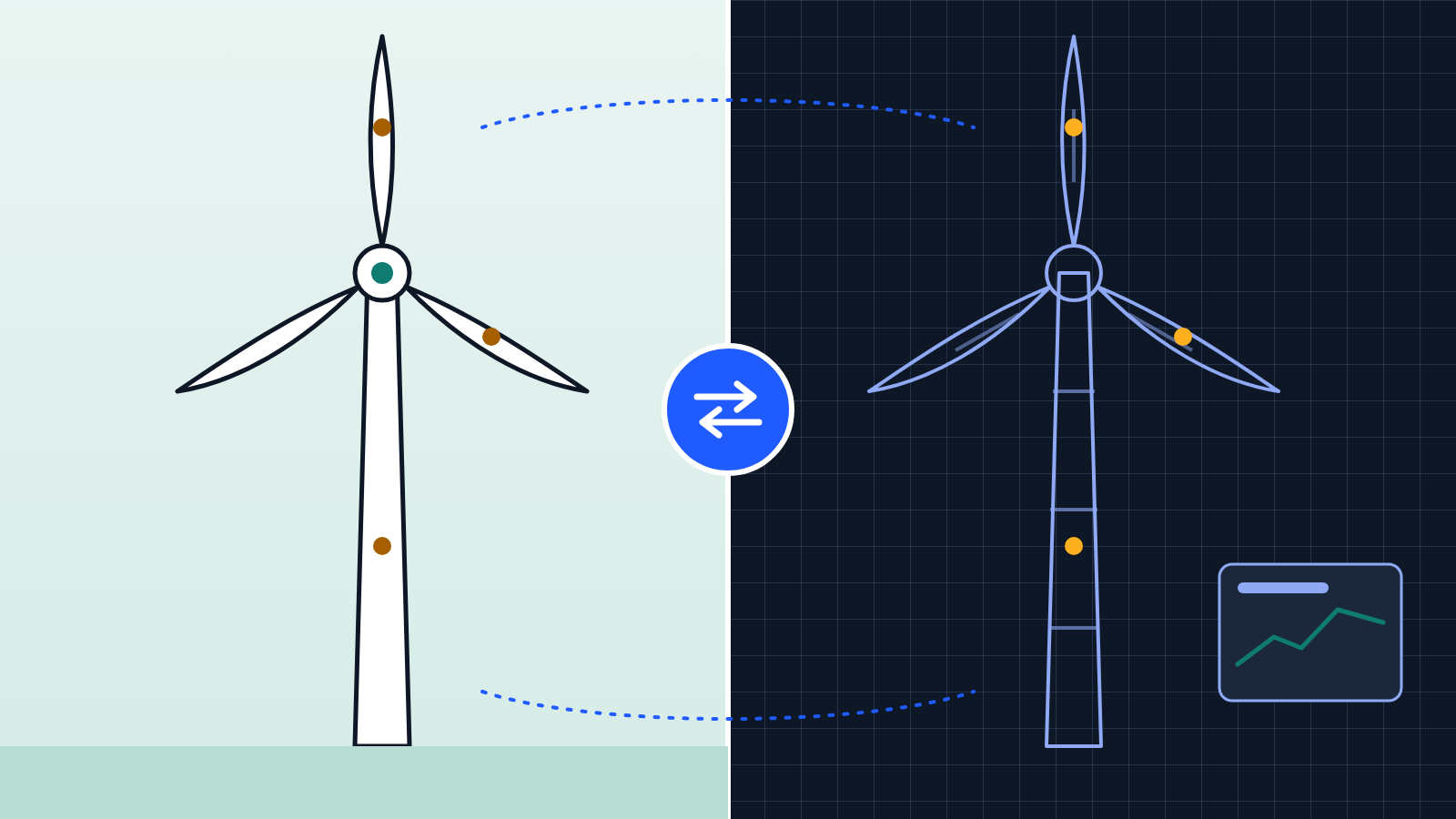
Data flows automatically both ways. The twin analyses live readings, works out the best settings and sends adjustments — or maintenance orders — back.
If it only shows you what's happening, it's a shadow. If it can also change what happens — adjusting a machine or triggering a repair — it's a twin.
Why the pretty 3D model matters least
Picture a gas turbine spinning at 3,600 RPM. A detailed 3D image of its outer casing tells an engineer nothing about whether the blades inside are wearing out from heat and stress. What the engineer actually needs is:
- Accurate, frequent sensor data — temperatures, vibration, pressure and fuel flow.
- Estimates of what can't be measured — mathematical techniques that work out hidden values, like the temperature inside a blade, from the readings that are available.
- Wear forecasts — proven engineering models of how cracks grow and damage builds up, used to predict how long each part has left [5].
A digital twin with nothing but a simple line chart for a screen can be far more valuable than a beautiful 3D model with no live data behind it.
Marketing twin vs. real twin
Marketing twin
- Focus: realistic 3D graphics
- Data updated occasionally, in batches
- Read-only — can't change anything
- Built with game engines and VR
- Mainly serves PR and executive tours
- Biggest problem: the graphics lag
Real industrial twin
- Focus: accurate data and physics
- Data streams in continuously, within seconds
- Two-way — tunes settings or triggers repairs
- Built with industrial messaging, time-series databases and engineering models
- Serves operations and reliability engineers
- Biggest problems: sensor drift, timing errors, models drifting from reality
How a digital twin is built
The core challenge is connecting two very different worlds: the factory floor, where machines must respond in milliseconds and safety comes first, and the IT world of cloud storage and data analysis. A typical twin is built in five layers:
- Analytics and control — wear forecasts, simulations, and links to maintenance software such as SAP or IBM Maximo
- Data platform — streaming tools and databases that store readings over time
- Edge computers — rugged computers near the machines that translate and condense the data
- Sensors and controls — vibration, pressure, temperature and flow sensors, plus motor drives and controllers
- The physical asset — the turbine, pump, machine tool or plant itself
Edge computers: the translators
Most industrial sites run equipment spanning four decades, speaking many incompatible languages. Streaming all that raw data straight to the cloud would swamp the network and expose fragile factory systems to attack. Instead, rugged edge computers sit between the machines and the wider network [6]. They:
- Collect data locally from controllers and sensors in their native formats.
- Crunch the numbers on the spot — turning thousands of raw vibration readings per second into a few summary figures, so only the useful information is sent on.
- Send only what's changed — for example, staying quiet until a temperature moves by more than 0.2°C.
Speaking a common language
To scale up without being locked into one vendor, organisations should standardise on two open protocols:
MQTT with Sparkplug B
- A lightweight way to stream data from the factory to the cloud [7]
- Standard naming, so every system knows what each reading means
- Announces when a device comes online and alerts instantly if it drops off, so the twin knows when data has gone stale
- Compact binary format that saves bandwidth
OPC UA
- The global standard for describing industrial equipment [8]
- Machines are described meaningfully — e.g. "Pump 1, bearing vibration" — rather than as anonymous memory addresses
- Ready-made models for common machine types, like robots, packaging lines and plastic moulding
- Can synchronise in under a millisecond for high-speed control
Storing the data
Seconds to hours
Fast streaming tools and time-series databases power live monitoring, alerts and automatic adjustments. Clever compression lets them take in millions of readings per second without huge storage costs [9].
Months to decades
Older data moves to cheaper long-term storage, where it's used to study wear over time, rerun engineering simulations and retrain AI models.
Where digital twins are used today
Digital twins work at every scale — from a single component to an entire city's infrastructure.
Offshore wind turbines
Modern offshore turbines produce 8–15 MW, with blades over 100 metres long, and an unplanned repair trip can cost more than $300,000. Operators such as Siemens Gamesa and Ørsted give each turbine its own twin, fed by strain sensors in the blades and vibration and sound sensors on the gearbox [10]. It tracks fatigue damage as it builds up.
- Across a wind farm, the twin turns front-row turbines 2–5° to steer their turbulent wake away from the turbines behind
- Total farm output rises by roughly 1–3.5%, with less wear across the fleet [11]
Cooling plants
Cooling can use up to 40% of the electricity in large buildings, data centres and hospitals — yet most systems run on fixed seasonal settings. A twin models the efficiency of every chiller, fan and pump, and every 10–15 minutes recalculates the settings that meet cooling needs with the least power.
- 15–28% lower electricity use, with no loss of comfort [12]
Chip factories
In semiconductor plants like those run by TSMC and Intel, hundreds of machines feed one facility-wide twin [13]. Instead of waiting hours to inspect wafers physically, the twin estimates their quality in real time from machine readings.
- Spots drift early, before whole batches are ruined
- Schedules machine cleaning exactly when it's needed, avoiding unnecessary downtime
Water networks and ports
Thames Water in London and PUB in Singapore combine pipe maps, water-flow models and live sensors to find bursts within minutes and pinpoint leaks to within metres [14]. The ports of Rotterdam and Antwerp-Bruges combine ship tracking, tide and weather forecasts, cranes and rail schedules in one twin [15].
- Less water lost to leaks, and fewer pressure surges that burst mains
- Shorter ship waiting times, lower fuel emissions and busier cranes
The business value
Digital twins pay off in three main ways: preventing surprise breakdowns, testing decisions safely before making them, and making expensive equipment last longer.
Three approaches to maintenance
Run until it breaks
The machine runs until something fails. Production stops suddenly, and the failure often damages other equipment too. The most expensive option.
Service on a schedule
Parts are serviced every set number of hours or months. Healthy parts get thrown away early, while parts under heavy strain can still fail before their service date.
Service when the twin says so
The twin tracks real wear and forecasts how long each part has left. It can ease the load on a stressed machine and book maintenance at exactly the right time.
The key insight: not every operating hour is equal. An hour at 110% load during a 38°C heatwave wears a machine out far faster than an hour at 70% load on a mild morning. A twin accounts for this, updating its wear forecasts using live stress readings and proven models of how metal cracks grow [5].
Testing "what if" without the risk
- Pushing the limits safely. A refinery manager can ask: "If we raise output by 14% on a 35°C day, will our heat exchangers overheat or our pumps start to fail?" The twin simulates it faster than real time — before anyone touches a valve.
- Rehearsing emergencies. Power plants, grid operators and chemical plants practise emergency shutdowns and restarts on their twins, strengthening their procedures for rare but dangerous events.
What the numbers show
25–50%
less unplanned downtime [16, 17]
10–30%
lower maintenance costs [16]
5–15%
longer equipment life [17]
8–22%
lower energy use [12, 17]
Rolls-Royce jet engines
Under its TotalCare service, Rolls-Royce keeps digital twins of thousands of in-service engines, such as the Trent series [18]. Engines send temperatures, pressures, speeds and vibration via satellite during flight, and the twins model blade wear and other degradation. By predicting problems weeks ahead, Rolls-Royce cut in-flight engine shutdowns, extended time on the wing by over 20%, and turned maintenance from an unpredictable cost into a subscription service.
Common pitfalls — and how to avoid them
Despite the strong returns, many digital twin projects stall. Two traps catch most teams:
The 3D trap
Projects often spend 60–80% of their budget on photorealistic 3D visuals, while neglecting sensor quality, network reliability and clean, well-timed data.
Fix: Get the data right first. Build the data pipeline and analysis, then add 3D only where it genuinely helps technicians.
Sensors that drift
Sensors get dirty, connections corrode and clocks drift. A 5% sensor error or a 50-millisecond timing glitch can make the twin raise false alarms — or miss real failures.
Fix: Check sensors automatically. Cross-check readings against each other (does the pressure drop match the flow?), and suspect the sensor before the machine.
Security when the twin can control machines
Once a twin can change how a machine runs, it becomes a target. An attacker who breaks in could change settings or switch off safety limits — potentially causing fires, explosions or loss of life, as the Stuxnet and Triton attacks showed was possible [19]. Follow the IEC 62443 security standard:
- Advise first, act second. The twin should mainly recommend changes, which local safety systems and controllers check before anything happens.
- Hard-wire the safety limits. Pressure relief valves, emergency shutdowns and temperature cut-offs must be wired so no software command can override them.
- Verify every command. Every instruction from the twin must be encrypted, digitally signed and sent between devices that prove their identity with tamper-resistant hardware.
- Use one-way links where possible. "Data diodes" physically allow data out of high-security areas while blocking anything from coming in.
Avoid vendor lock-in with open standards
- Asset Administration Shell (IEC 63278) — a standard "digital ID card" for industrial equipment, backed by Germany's Industrie 4.0 initiative [20].
- Digital Twin Consortium — an international group publishing vendor-neutral frameworks for building twins that work together [21].
- Digital Twins Definition Language (DTDL) — an open language for describing what a twin measures, its settings, commands and relationships.
A four-stage plan to get started
Resist the urge to build a twin of the entire factory. Successful teams follow a step-by-step path:
Pick the right asset
Choose one to three critical machines, ranked by hourly downtime cost × likelihood of failure. Work out which parts fail, why, and which signal would give the earliest warning.
Add sensors and a data pipeline
Fit calibrated sensors to measure those warning signs. Install edge computers to process and filter data locally, then stream it via MQTT Sparkplug B into a time-series database.
Build the brain and test it
Build models that estimate hidden values and describe how the machine behaves, and learn what "normal" vibration looks like. Run the twin in watch-only mode for 3–6 months, comparing its predictions with what inspections actually find, and fine-tune.
Close the loop
Let the twin raise maintenance work orders and reserve spare parts automatically. Then allow supervised adjustments — for example, slowing a compressor by 8% to protect an overheating bearing until its repair — always behind hard-wired safety limits.
Five lessons for business leaders
- Data beats graphics. Reject proposals that put 3D visuals ahead of reliable, real-time data and accurate models. A twin's value comes from how well it predicts, not how good it looks.
- Insist on two-way data. A read-only dashboard is a shadow, not a twin. A real twin feeds back — by adjusting settings or triggering maintenance.
- Use open standards. Avoid lock-in by requiring MQTT with Sparkplug B, OPC UA and the Asset Administration Shell.
- Put safety first. Once a twin can change how machines run, treat that link as safety-critical. Keep hard-wired safety systems that software can never override.
- Start small. Don't try to twin a whole plant or power grid at once. Begin with one critical asset, prove the savings, then expand.
Sources
Every figure in this article comes from the sources below.
- Grieves, M. (2002/2014). "Digital Twin: Manufacturing Excellence through Virtual Factory Replication." White paper, University of Michigan / Digital Twin Institute.
- Vickers, J., Shafto, M. et al. (2010/2012). "Modeling, Simulation, Information Technology & Processing Roadmap: Technology Area 11." NASA.
- Kritzinger, W., Karner, M., Traar, G., Henjes, J. & Sihn, W. (2018). "Digital Twin in manufacturing: A categorical literature review and classification." IFAC-PapersOnLine 51(11), 1016–1022.
- ISO 23247 (2021). Automation systems and integration — Digital twin framework for manufacturing, Parts 1–4.
- Paris, P. C., Gomez, M. P. & Anderson, W. E. (1961). "A rational analytic theory of fatigue." The Trend in Engineering 13(1), 9–14; Miner, M. A. (1945). "Cumulative damage in fatigue." Journal of Applied Mechanics 12(3), A159–A164.
- Williams, T. J. et al. (1994). "The Purdue Enterprise Reference Architecture."
- Eclipse Foundation & Cirrus Link (2019/2022). Sparkplug B: MQTT Topic & Payload Definition.
- OPC Foundation / IEC (2020). IEC 62541: OPC Unified Architecture.
- Pelkonen, T. et al. (2015). "Gorilla: A Fast, Scalable, In-Memory Time Series Database." Proceedings of the VLDB Endowment 8(12), 1816–1827.
- Siemens Gamesa & NREL (2021/2023). Aeroelastic simulation and digital twin modelling of offshore wind turbines.
- Meyers, J. & Meneveau, C. (2012). "Optimal turbine spacing in fully developed wind farm boundary layers"; Fleming, P. et al. (2020). Wake steering field trials. Wind Energy Science 5(4), 1545–1559.
- US Department of Energy, FEMP & PNNL (2020). "Continuous Commissioning and Thermodynamic Optimization of Central Chiller Plants."
- Moyne, J. & Iskandar, J. (2017). "Big Data Analytics for Semiconductor Manufacturing." IEEE Transactions on Semiconductor Manufacturing 30(4), 317–328.
- Rossman, L. A. (2000/2020). EPANET 2 Users Manual. US EPA; Thames Water / UKWIR (2022). Real-time hydraulic digital twins for leak detection.
- Port of Rotterdam Authority (2021). "The Digital Twin of the Port of Rotterdam."
- McKinsey & Company (2022). "Digital twins: The art of the possible in product development and operations."
- Gartner (2021/2023). "Survey Analysis: Digital Twins in Industrial Enterprises."
- Rolls-Royce plc (2020/2022). "IntelligentEngine and TotalCare Services."
- IEC (2018/2021). IEC 62443: Security for industrial automation and control systems.
- Plattform Industrie 4.0 & BMWK (2020/2022). "Details of the Asset Administration Shell, Part 1" (IEC 63278).
- Digital Twin Consortium (2021/2023). "Digital Twin System Interoperability Framework" and "Capabilities Periodic Table."