
How AI Could Change Healthcare Delivery
Health systems everywhere face the same squeeze: more patients with more complex needs, and not enough staff to care for them. Artificial intelligence is increasingly presented as part of the answer — reading scans, drafting clinical notes, flagging patients at risk and answering routine questions. Some of these uses are already backed by solid evidence; others are still unproven. Here's where AI is changing how care is delivered, what the research says, and what needs to be in place for it to help rather than harm.
- The WHO projects a global shortage of 11.1 million health workers by 2030 — a major reason health systems are turning to AI.
- The US FDA had authorised 1,451 AI-enabled medical devices by the end of 2025; 76% of them are for radiology.
- In a large Swedish trial, AI-supported breast screening found 20% more cancers while cutting radiologists' reading workload by 44%.
- AI "scribes" that write up consultations reduced clinicians' documentation time and exhaustion in a randomised trial — but the gains were modest.
- AI tools can fail when used in new settings. Independent testing, human oversight and clear accountability are essential.
Why healthcare is looking to AI
The pressure on health systems is structural, not temporary. The World Health Organization estimates the world will be short of 11.1 million health workers by 2030, and warns that a large share of today's doctors are approaching retirement [1]. At the same time, ageing populations mean more people living with long-term conditions that need ongoing care.
Much of clinicians' time also goes on work that isn't direct care: writing notes, filling in forms, chasing results and coordinating appointments. That is where many health systems see the first, lowest-risk opportunities for AI — freeing up time for patients rather than replacing clinical judgement.
Six ways AI is entering care
AI is not one technology but a family of tools. These are the areas where it is most active today:
Reading medical images
AI flags suspicious areas on X-rays, CT scans and mammograms, or helps prioritise urgent cases on a radiologist's list. This is the most mature area of medical AI.
Writing clinical notes
"Ambient" AI scribes listen to a consultation (with consent) and draft the clinical note for the doctor to check and sign, so they can focus on the patient rather than the keyboard.
Spotting deterioration
Early-warning models scan vital signs and lab results to flag patients at risk of conditions such as sepsis, so staff can act sooner. Their accuracy varies widely in practice.
Triage and patient questions
Chatbots and online forms help direct patients to the right service, answer common questions and handle bookings, easing pressure on phone lines and front desks.
Running hospitals
Forecasting tools predict demand for beds, staff and operating theatres, helping managers plan rotas and reduce cancelled operations.
Developing treatments
AI helps researchers predict protein structures, screen drug candidates and find suitable patients for clinical trials — work that may pay off over years rather than months.
What the evidence shows so far
Medical AI is no longer experimental, but the strength of evidence varies a lot between uses.
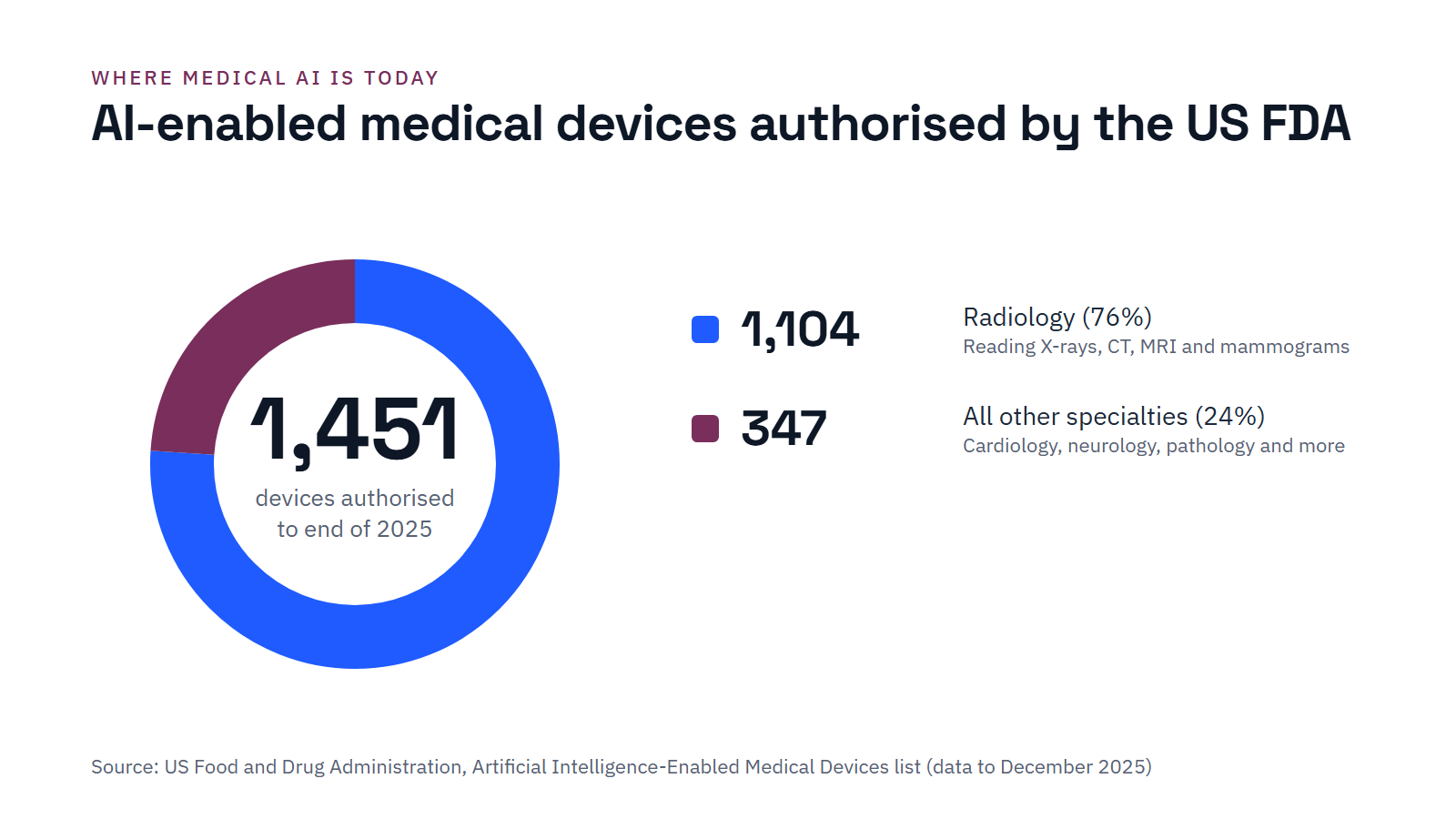
1,451
AI-enabled devices authorised by the US FDA by end-2025 — 76% for radiology [2]
+20%
more breast cancers detected with AI-supported screening, with 44% less reading workload [3]
11.1 million
projected global shortage of health workers by 2030 [1]
Imaging has the strongest evidence. In the MASAI trial in Sweden, more than 80,000 women were randomly assigned to standard screening by two radiologists or to AI-supported screening. The AI group had 20% more cancers detected, without a rise in false positives, while radiologists' screen-reading workload fell by 44% [3].
AI scribes show real but modest gains. In one of the first randomised trials of ambient AI scribes, 238 outpatient physicians across 14 specialties used one of two tools or continued as usual. Documentation time fell by roughly 10% for one tool, and doctors reported less work exhaustion — helpful, but far from the dramatic savings often claimed in marketing [4].
Most medical AI today is assistive: it gives a clinician a second opinion, a draft or an alert. A human still makes the decision and remains responsible for it. Fully autonomous AI diagnosis is rare and tightly regulated.
Where AI can go wrong
An AI model can perform well in the hospital where it was built and badly somewhere else. A widely used sepsis prediction model, when independently tested at a US academic health system, missed about two-thirds of sepsis cases while generating many false alarms — far worse than its developer's figures suggested [5].
In healthcare, an AI tool is only as good as its performance on your patients, in your hospital, today.
- Bias. Models trained mostly on data from some groups may work less well for others, widening existing health inequalities.
- Over-reliance. Busy staff may accept AI suggestions without enough scrutiny — or tire of alerts and ignore them.
- Privacy. Health data is highly sensitive. Patients need to know how their information is used and protected.
- Accountability. When an AI-assisted decision goes wrong, it must be clear who is responsible.
The rules are catching up
Regulators are moving to manage these risks. In the US, AI tools that diagnose or guide treatment are reviewed by the FDA as medical devices [2]. Under the EU's AI Act, AI used in medical devices is classed as high-risk, with requirements for data quality, transparency and human oversight [6]. The WHO has also published guidance on the ethics and governance of large AI models in health, stressing transparency, accountability and protection of patient data [7].
What health organisations should do
- Start with the burden, not the buzz. Target time-consuming tasks with clear measures, such as documentation, scheduling or image triage.
- Test locally before trusting. Check how a tool performs on your own patients and data before rolling it out, and keep monitoring afterwards.
- Keep clinicians in charge. Make it clear that AI supports decisions; it doesn't make them.
- Involve patients and staff. Explain what the tool does, get consent where needed, and listen to concerns.
- Measure what matters. Track patient outcomes, safety incidents and staff time — not just how many people use the tool.
What to watch next
- National screening programmes deciding whether to adopt AI as a routine second reader.
- Long-term outcomes from AI scribe and triage deployments, beyond short pilot studies.
- EU AI Act obligations for high-risk medical AI coming into force.
- Generative AI in clinical decisions — and how regulators treat chatbots that give medical advice.
- Workforce effects — whether time saved by AI actually turns into more time with patients.
Sources
Every figure in this article comes from the sources below.
- World Health Organization (2025). World Health Statistics 2025; WHO health workforce projections.
- US Food and Drug Administration. "Artificial Intelligence-Enabled Medical Devices" list (data to December 2025), as analysed by Radiology Business and AuntMinnie.
- Lång, K. et al. (2023). "Artificial intelligence-supported screen reading versus standard double reading in the Mammography Screening with Artificial Intelligence trial (MASAI)." The Lancet Oncology 24(8), 936–944.
- "A Randomized Clinical Trial of Two Ambient Artificial Intelligence Scribes: Measuring Documentation Efficiency and Physician Burnout." NEJM AI (2025); UCLA Health.
- Wong, A. et al. (2021). "External Validation of a Widely Implemented Proprietary Sepsis Prediction Model in Hospitalized Patients." JAMA Internal Medicine 181(8), 1065–1070.
- Regulation (EU) 2024/1689 (Artificial Intelligence Act). Official Journal of the European Union.
- World Health Organization (2024). Ethics and governance of artificial intelligence for health: Guidance on large multi-modal models.