
Smart Agriculture and the Connected Farm
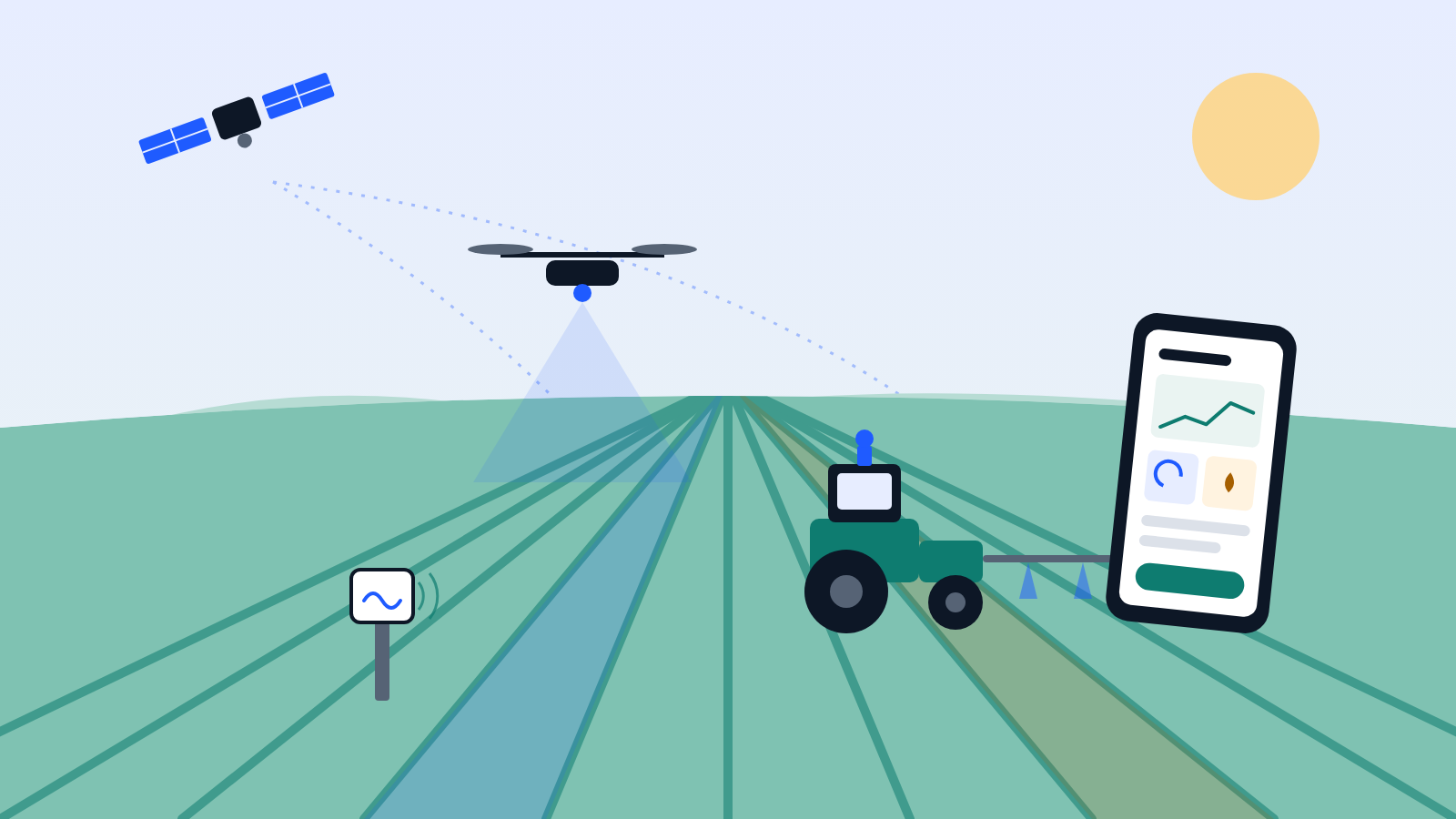
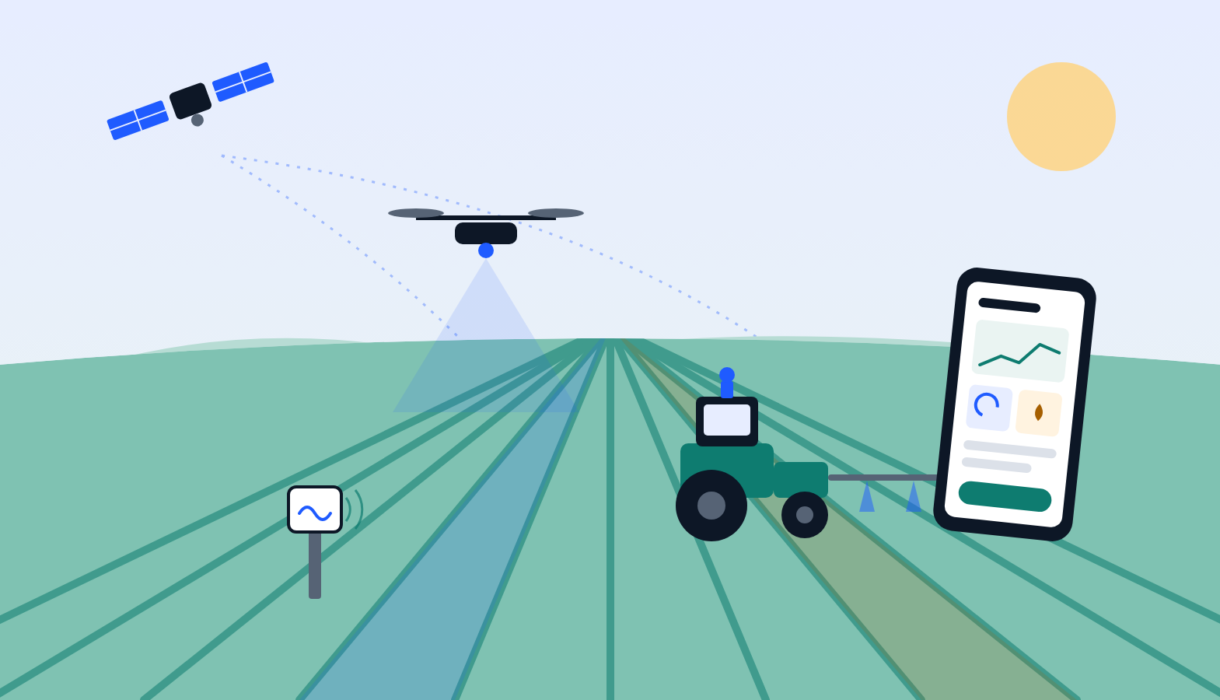
Farming has always depended on reading the land, the weather and the crop. Today, farmers can do that with satellites, drones, soil sensors and machines that steer themselves. Data and automation are helping farms use less water, fertiliser and chemicals while protecting yields — but the benefits are not yet shared evenly. Here's how the connected farm works, what the evidence shows, and what stands in the way.
- Agriculture accounts for about 70% of global freshwater withdrawals, and the FAO estimates the world will need roughly 50% more food, feed and fibre by 2050 than in 2012.
- Precision agriculture uses data to apply water, seed, fertiliser and chemicals only where they're needed.
- Camera-guided spraying cut herbicide use by an average of 59% across more than 1 million acres in 2024, according to its maker; independent university trials found savings of 44–87%.
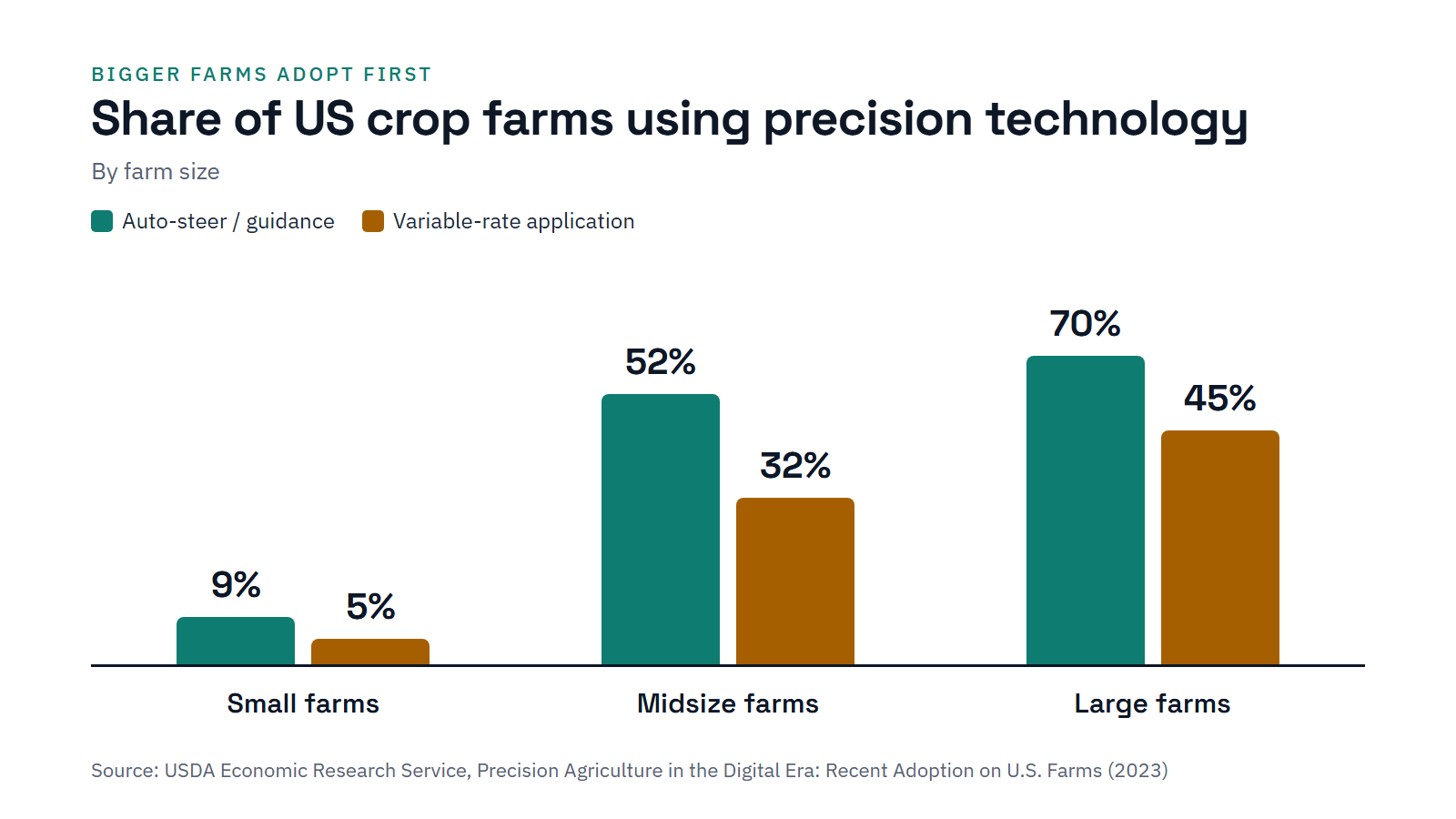
- Adoption depends heavily on farm size: 70% of large US crop farms use auto-steer, against just 9% of small farms.
- Connectivity, cost, skills and questions about who owns farm data are the biggest barriers.
Why farms need to get smarter
Agriculture faces a squeeze from several directions at once. The UN Food and Agriculture Organization (FAO) estimates that, as the world population approaches 10 billion by 2050, agriculture will need to produce around 50% more food, feed and fibre than in 2012 [1]. At the same time, farming already uses about 70% of all freshwater withdrawals, and much farmland is affected by soil degradation [1, 2].
Add climate change, volatile fertiliser and fuel prices, and labour shortages in many countries, and the case for producing more with less becomes urgent. That is the promise of smart agriculture.
Precision agriculture means treating each part of a field according to its needs, instead of treating the whole field the same way. Sensors and maps show where the crop is thriving or struggling, and machines adjust what they apply — metre by metre.
The technologies behind the connected farm
Most smart-farming systems combine several of these building blocks:
GPS guidance and auto-steer
Tractors steer themselves along exact lines, cutting overlaps and gaps. That saves fuel, seed and chemicals, and reduces driver fatigue.
Yield and soil maps
Harvesters record how much each part of a field produced. Combined with soil tests, these maps show where to invest and where inputs are being wasted.
Variable-rate technology
Machines change the amount of seed, fertiliser or lime they apply as they cross a field, following a prescription map.
Camera-guided spraying
Cameras on the spray boom spot individual weeds and trigger nozzles only where they're needed, instead of spraying the whole field.
Soil and weather sensors
Connected probes measure soil moisture and temperature, helping farmers irrigate only when and where crops need water.
Drones and satellites
Aerial images reveal crop stress, disease and water problems early — often before they're visible from the ground.
What the evidence shows
The strongest evidence so far comes from technologies that cut wasted inputs.
59%
average herbicide savings with camera-guided spraying across 1M+ acres in 2024 (manufacturer data) [3]
44–87%
herbicide reduction in Iowa State University field trials [4]
~70%
of global freshwater withdrawals go to agriculture [2]
Targeted spraying is a clear example. John Deere reports that customers using its See & Spray system saved an average of 59% of herbicide on more than 1 million acres in 2024, and almost 50% of non-residual herbicide across more than 5 million acres in 2025 [3]. Independent field-scale trials by Iowa State University found reductions ranging from 44% to 87% [4]. Profit gains from older precision tools are more modest: US Department of Agriculture research found GPS mapping, guidance and variable-rate technology each raised operating profits on corn farms by roughly 1–2% [5].
The biggest win from smart farming is often not more yield, but less waste — of water, chemicals, fuel and time.
Who is adopting — and who isn't
Adoption is closely tied to farm size. According to the USDA's Economic Research Service, auto-steer and guidance systems are used on 70% of large US crop farms and 52% of midsize farms, but just 9% of small farms. Variable-rate application follows the same pattern: 45%, 32% and 5% [5].
The reason is simple economics. Equipment and subscriptions are expensive, and the savings grow with the number of acres. For smallholder farmers — who produce a large share of the world's food in lower-income countries — cheaper tools such as mobile phone advisory services, weather alerts and shared equipment are often more realistic first steps.
The barriers
Even where the technology works, several obstacles slow its spread:
- Connectivity. Many rural areas still lack reliable mobile or broadband coverage, which connected sensors and machines depend on.
- Cost and payback. High upfront costs and uncertain returns make it hard for smaller farms to invest.
- Skills and time. Turning data into decisions takes training, and farmers are already stretched.
- Data ownership. Farmers want to know who controls the data their machines collect, and whether it could be used against their interests.
- Compatibility. Equipment and software from different makers don't always work together, locking farmers into one supplier.
Practical steps for farmers
- Start with the biggest cost. Fuel, fertiliser, herbicide or water — target the input where savings would matter most.
- Use what you have. Many modern tractors and harvesters already collect data that goes unused.
- Trial on part of the farm. Compare a treated strip with a normal one before committing across every field.
- Share where possible. Contractors, co-operatives and equipment-sharing schemes spread the cost.
- Read the data terms. Check who can access and use your farm data before signing up.
What to watch next
- Farm robots for weeding, picking and milking, as labour shortages grow.
- AI crop advice delivered by phone to smallholder farmers.
- Rural connectivity, including satellite internet reaching remote farms.
- Data rules giving farmers more control over the data their equipment generates.
- Climate reporting, as buyers ask farms to prove lower emissions and chemical use.
Sources
Every figure in this article comes from the sources below.
- FAO (2017). The future of food and agriculture: Trends and challenges. Food and Agriculture Organization of the United Nations.
- FAO. AQUASTAT — Global information system on water and agriculture.
- John Deere (2024, 2025). "See & Spray customers see 59% average herbicide savings in 2024" and "John Deere customers use See & Spray technology across five million acres in 2025." News releases.
- Iowa State University field-scale trials of See & Spray (2024 growing season), as reported by CropLife and Farms.com.
- McFadden, J., Njuki, E. & Griffin, T. (2023). Precision Agriculture in the Digital Era: Recent Adoption on U.S. Farms. USDA Economic Research Service, EIB-248; Schimmelpfennig, D. (2016). Farm Profits and Adoption of Precision Agriculture. USDA ERS, ERR-217.