How AI Is Changing the Workplace — and What It Leaves Unchanged
Posted in :

How AI Is Changing the Workplace — and What It Leaves Unchanged
Headlines about AI and work tend to swing between two extremes: either machines are about to take everyone's job, or nothing much will change. The evidence points somewhere in between. Most jobs are bundles of tasks, and AI is changing some of those tasks quickly, others slowly, and many hardly at all. Looking at work task by task gives a far clearer picture of what's really happening — and what workers and employers can do about it.
- AI use at work is already widespread: 75% of knowledge workers surveyed by Microsoft and LinkedIn said they use generative AI on the job.
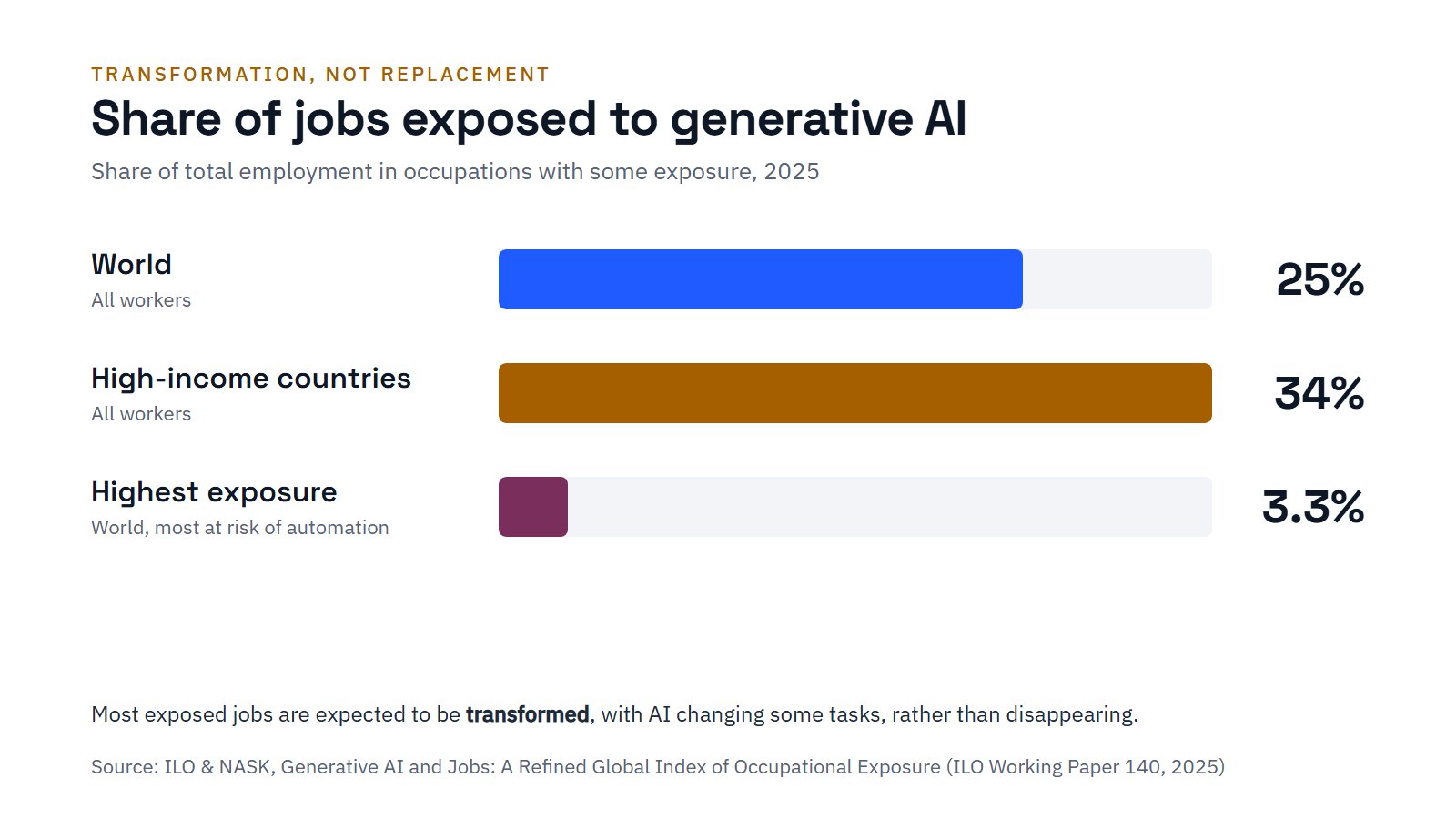
- The ILO estimates that one in four jobs worldwide is exposed to generative AI, but only 3.3% are in the highest-exposure group. Transformation is far more likely than replacement.
- Productivity gains are real in specific tasks, especially for less experienced staff, but broad effects on wages and hours have so far been small.
- Judgement, relationships, physical skill and accountability remain firmly human.
- The biggest change may be in skills: employers expect 39% of workers' core skills to change by 2030.
Jobs are bundles of tasks
A marketing manager doesn't do one thing. They write briefs, analyse campaign results, manage a budget, negotiate with agencies, coach their team and present to senior leaders. AI might draft the brief and summarise the results in minutes — but it won't run the negotiation or win the room. That's why economists increasingly study AI's effect on tasks rather than whole occupations.
A job is rarely "automated" all at once. Instead, AI takes over some tasks, helps with others and leaves the rest untouched. The result is usually a changed job, not a vanished one.
AI does it
Routine, rules-based tasks: transcribing meetings, sorting emails, filling standard forms, first-draft translations, basic data entry.
AI helps, a person decides
Drafting reports, writing code, analysing data, researching a topic, answering customer queries — faster with AI, but checked by a human.
Still human work
Building trust, leading people, handling sensitive situations, hands-on physical work and taking responsibility for decisions.
What's changing — and how fast
AI has spread through offices faster than almost any previous workplace technology. In Microsoft and LinkedIn's 2024 Work Trend Index, 75% of knowledge workers said they used generative AI at work, and 78% of those users were bringing their own AI tools rather than waiting for their employer to provide them [1].
Which jobs are most affected? A 2025 global index by the International Labour Organization (ILO) and Poland's NASK research institute, built from nearly 30,000 work tasks, found that about one in four jobs worldwide is in an occupation exposed to generative AI — rising to 34% in high-income countries. Clerical jobs are the most exposed. But only 3.3% of jobs fall into the highest-exposure category, where automation is most likely [2].
75%
of knowledge workers use generative AI at work [1]
1 in 4
jobs worldwide exposed to generative AI [2]
3.3%
of jobs in the highest-exposure group [2]
Exposure isn't spread evenly. The ILO found women are more exposed than men, because they're over-represented in clerical and administrative roles: in high-income countries, 9.6% of women's jobs fall into the highest-exposure category, compared with 3.5% of men's [2].
What the productivity evidence says
Controlled studies show AI can make specific tasks much faster. In a study of 5,179 customer-support agents, an AI assistant raised the number of issues resolved per hour by 14% on average — and by 34% for the least experienced agents [3]. A Harvard Business School and BCG experiment found consultants using AI completed tasks faster and to a higher standard — but performed worse on a problem outside AI's strengths [4].
Across the wider labour market, though, the effects have so far been modest. A large study of workers in Denmark found that AI chatbots had not significantly changed earnings or hours worked in any of the occupations studied, with average time savings of around 3% of working hours [5].
AI can transform a task overnight. Transforming a job, a team or an economy takes much longer.
The gap between task-level gains and economy-wide impact isn't unusual. Earlier technologies — from electricity to personal computers — took years to show up in productivity statistics, because organisations had to redesign how work was done around them.
What AI leaves unchanged
Some parts of work remain stubbornly human, and are likely to become more valuable as routine tasks are automated:
Judgement and accountability
Someone still has to decide, sign off and answer for the outcome — especially where money, safety, health or the law is involved.
Relationships and trust
Negotiating, persuading, caring for patients, managing a team and calming an angry customer all depend on human connection.
Physical skill
Plumbers, nurses, electricians and chefs work in messy, varied physical environments that software alone can't handle.
Context and experience
Knowing the unwritten rules of an organisation, a client or a community — and when to break them — comes from experience.
The new work AI creates
AI also creates tasks. Someone has to check its output, design workflows around it, manage the data it relies on, and make sure it's used fairly and safely. The World Economic Forum's Future of Jobs Report 2025, based on a survey of more than 1,000 large employers, expects 170 million new jobs and 92 million displaced jobs between 2025 and 2030 — a net gain of 78 million — driven by technology, the green transition and demographic change together [6].
The same employers expect 39% of workers' core skills to change by 2030, with AI and big data, technology literacy, creative thinking, resilience and curiosity among the fastest-growing skills [6].
What employers and workers can do
- Map jobs task by task to see where AI helps and where it doesn't.
- Redesign roles around the time AI frees up, not just headcount.
- Provide approved tools and clear rules, so staff don't rely on unvetted apps.
- Invest in training, especially for the people whose tasks change most.
- Keep humans accountable for important decisions.
- Experiment with AI on low-risk parts of your job to learn what it does well.
- Always check AI output before you rely on it.
- Build the skills AI can't easily copy: judgement, communication and leadership.
- Keep learning: short courses and on-the-job practice both count.
- Speak up about where AI helps and where it gets in the way.
What to watch next
- AI agents that complete multi-step tasks, and whether they shift work from "assisted" to "automated".
- Entry-level jobs, where routine tasks traditionally helped newcomers learn the ropes.
- Productivity statistics, to see whether task-level gains start to show up economy-wide.
- Workplace rules on transparency, monitoring and consultation when AI is introduced.
- Who benefits — whether gains flow to workers through pay and shorter hours, or mainly to employers.
Sources
Every figure in this article comes from the sources below.
- Microsoft & LinkedIn (2024). 2024 Work Trend Index Annual Report: AI at Work Is Here. Now Comes the Hard Part.
- Gmyrek, P. et al. (2025). Generative AI and Jobs: A Refined Global Index of Occupational Exposure. ILO Working Paper 140, International Labour Organization and NASK.
- Brynjolfsson, E., Li, D. & Raymond, L. R. (2023). "Generative AI at Work." NBER Working Paper 31161; The Quarterly Journal of Economics (2025).
- Dell'Acqua, F. et al. (2023). "Navigating the Jagged Technological Frontier." Harvard Business School Working Paper 24-013.
- Humlum, A. & Vestergaard, E. (2025). "Large Language Models, Small Labor Market Effects." NBER Working Paper 33777.
- World Economic Forum (2025). The Future of Jobs Report 2025.