
What the Fourth Industrial Revolution Means for Small Businesses
Artificial intelligence, connected sensors, cloud software and automation are often discussed as tools for global corporations. But the Fourth Industrial Revolution is just as much a story about small firms. Many of these technologies are now available for a monthly subscription — and the gap between businesses that use them and those that don't is growing. Here's what the shift means for small businesses, where the opportunities and risks lie, and how to take the first steps.
- Technologies that once needed big budgets — AI, data analytics, automation — are now rented by the month through the cloud.
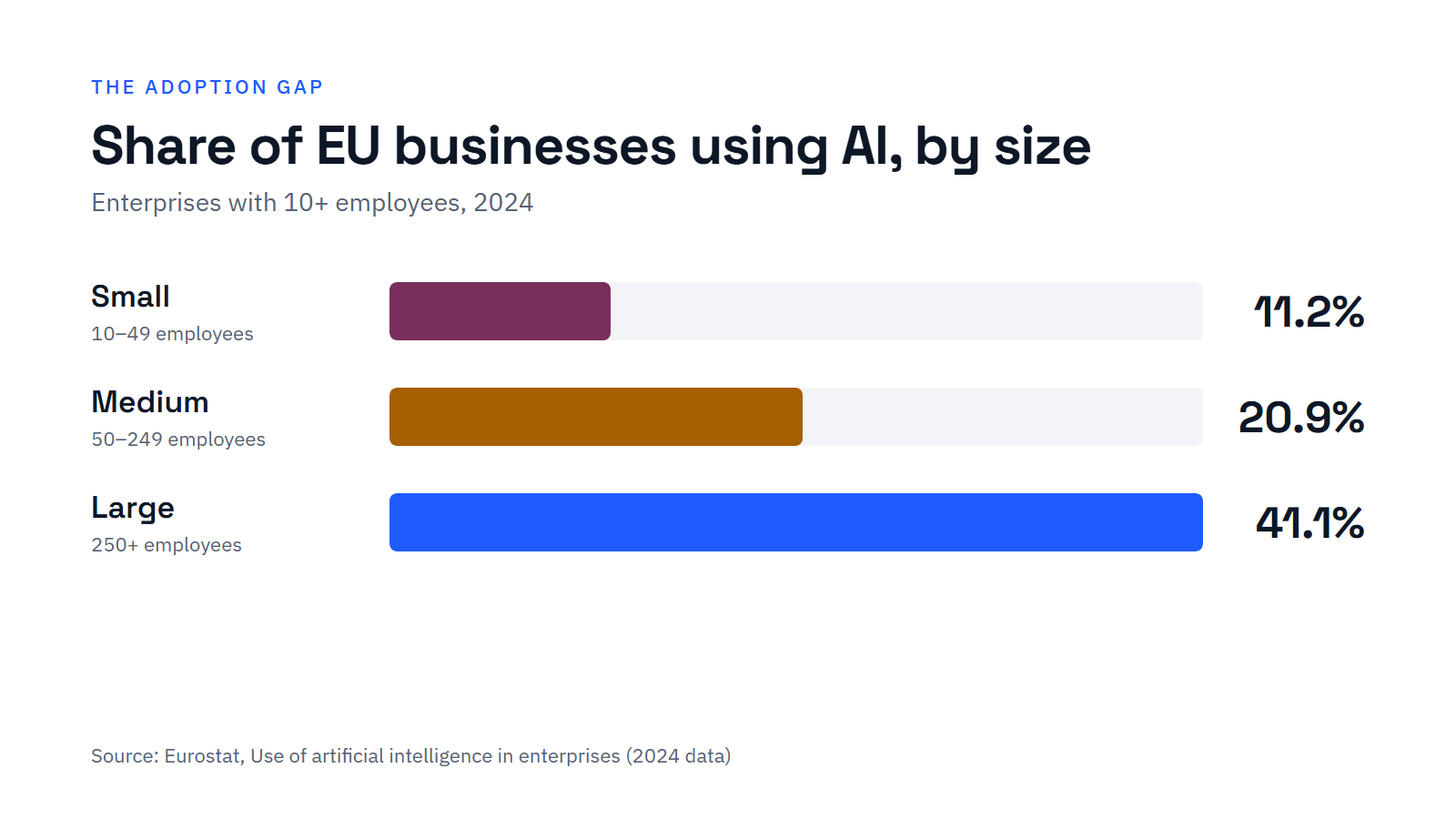
- Small firms still lag: in the EU, 11.2% of small businesses used AI in 2024, against 41.1% of large ones.
- The gap is closing fast. Among US small businesses, generative AI use rose from 23% in 2023 to 58% in 2025.
- Cyber security is the biggest new risk: around four in ten UK micro and small businesses reported a breach or attack in a year.
- The best approach is to start with one costly, repetitive problem, test a tool, and measure the result.
What is the Fourth Industrial Revolution?
The term was popularised by Klaus Schwab, founder of the World Economic Forum, in 2016 [1]. It describes a wave of technologies that blur the line between the physical, digital and biological worlds — from artificial intelligence and robotics to the Internet of Things, 3D printing and biotechnology.
What makes this wave different from the computer revolution that came before it is its speed and reach. New tools spread in months rather than decades, and they touch almost every industry at once — from farms and factories to accountancy firms and corner shops.
The first industrial revolution used steam, the second electricity, the third computers. The fourth connects all of these to data and intelligent software — so machines, products and processes can sense, learn and adjust on their own.
Why it matters for small firms
Small and medium-sized enterprises (SMEs) are the backbone of the economy. Across OECD countries they make up around 99% of all businesses and generate 50–60% of value added [2]. How quickly they adopt new technology has a big effect on national productivity and on local jobs.
The good news is that the cost of entry has collapsed. Ten years ago, advanced analytics or a customer-service chatbot meant hiring specialists and buying servers. Today, many of the same capabilities come built into accounting, e-commerce and office software that small firms already pay for each month.
The adoption gap — and how fast it's closing
Despite lower costs, small businesses still trail larger ones. According to Eurostat, 13.5% of EU enterprises with 10 or more employees used AI in 2024. But the figure was just 11.2% for small firms, compared with 20.9% for medium-sized firms and 41.1% for large ones [3]. Eurostat points to complexity and cost as the main reasons.
Yet the picture is changing quickly. The US Chamber of Commerce's annual small-business technology survey found that the share of small firms using generative AI tools — such as chatbots and image generators — jumped from 23% in 2023 to 40% in 2024 and 58% in 2025 [4].
11.2% vs 41.1%
EU small vs large firms using AI, 2024 [3]
23% → 58%
US small businesses using generative AI, 2023 to 2025 [4]
46%
UK small businesses reporting a cyber breach or attack in the past year [5]
The question for most small businesses is no longer whether they can afford these tools, but which ones are worth their time.
Four technologies within reach today
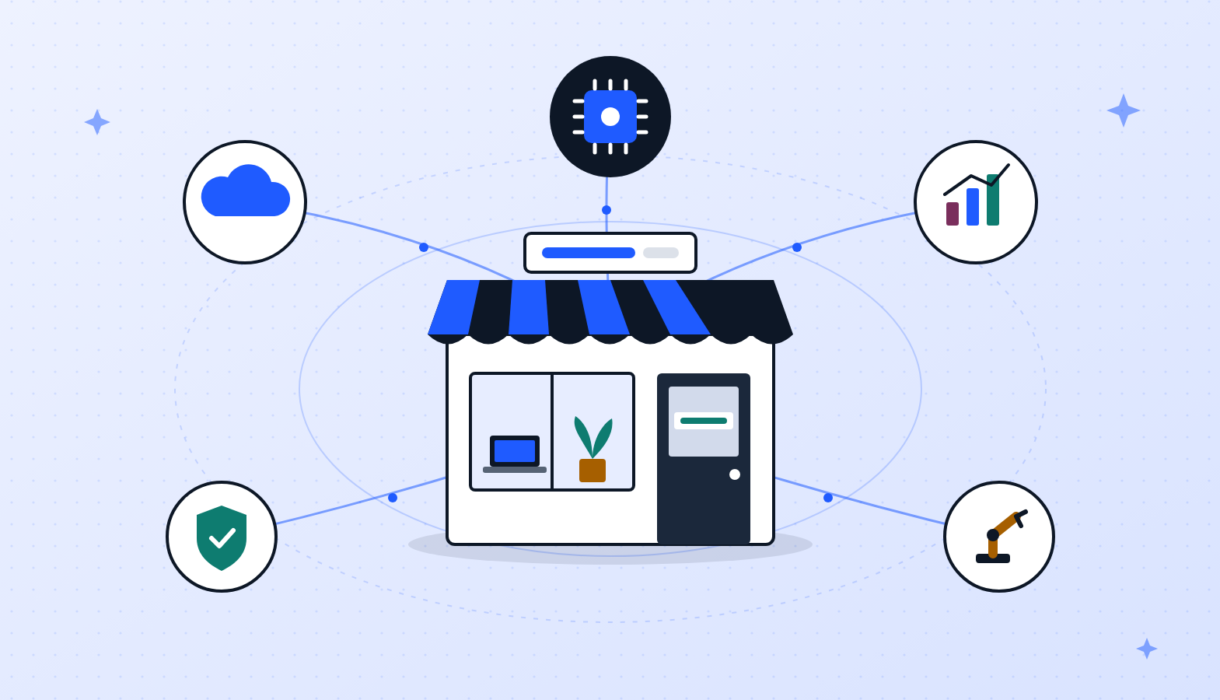
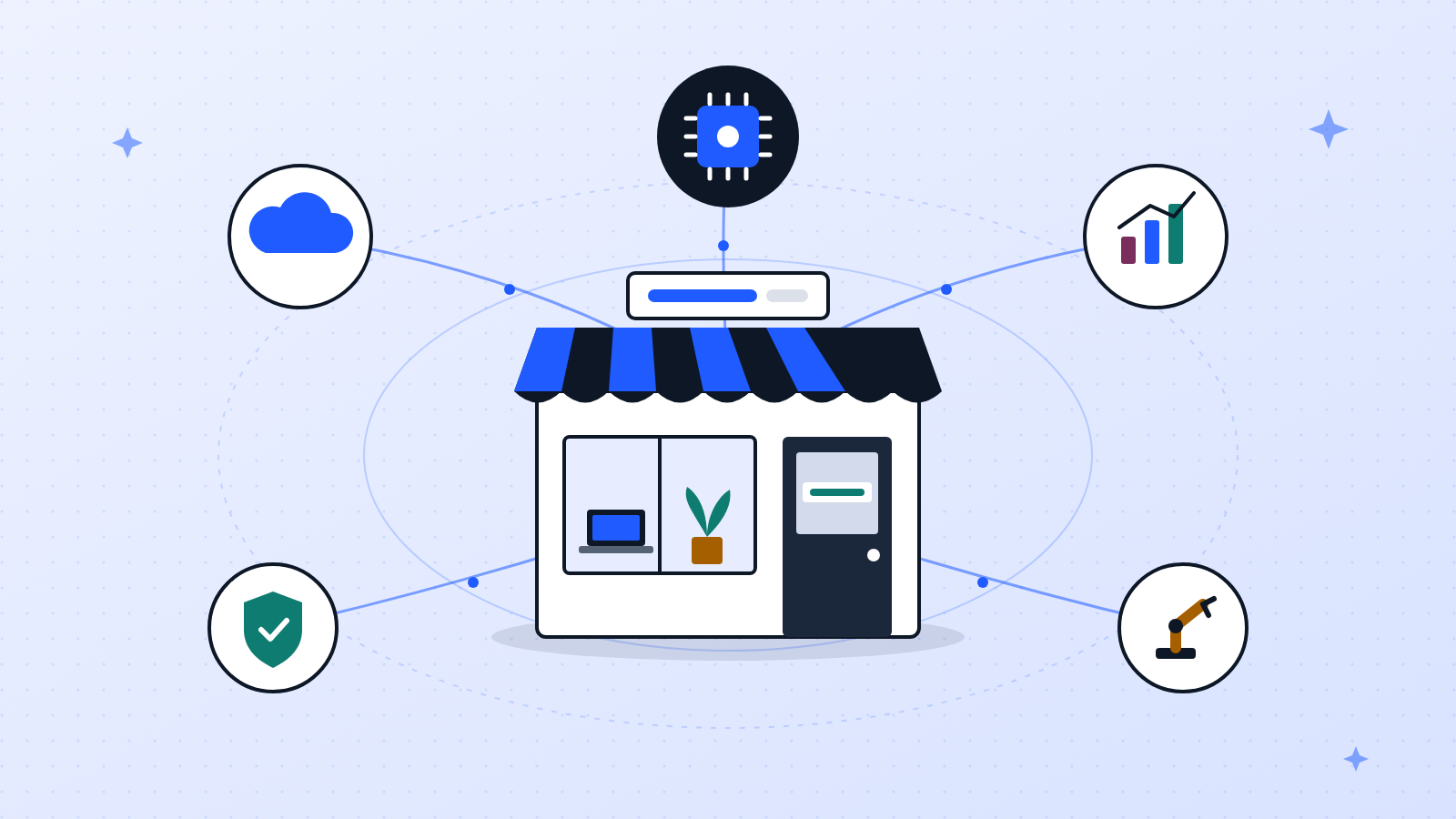
You don't need a robot army to benefit from the Fourth Industrial Revolution. These are the technologies small firms are most likely to use first:
Cloud software
Accounting, payroll, stock control and customer management run in a web browser for a monthly fee. No servers to buy, automatic updates, and data available from anywhere — the foundation for everything else.
AI assistants
Drafting emails, product descriptions and social posts; summarising documents; answering common customer questions. Studies show the biggest gains go to less experienced staff [6].
Connected sensors
Low-cost Internet of Things devices track fridge temperatures, energy use, stock levels or vehicle locations, and send alerts to a phone when something needs attention.
Automation
Software that moves data between apps, sends invoices and reminders, or books appointments automatically — and, in workshops and warehouses, smaller and cheaper collaborative robots.
What it can look like in practice
The following are illustrative examples — typical uses rather than specific companies — showing how small firms can apply these tools:
A local bakery
Sales data from its card terminal and the weather forecast feed a simple forecasting tool, helping it bake closer to real demand and throw away less unsold stock. A temperature sensor alerts the owner if a fridge fails overnight.
A plumbing firm
Customers book online; scheduling software plans the day's route for each van; an AI assistant turns the engineer's voice notes into a tidy job report and invoice before they've left the driveway.
An e-commerce shop
An AI tool drafts product descriptions for review, a chatbot answers "Where's my order?" questions around the clock, and analytics show which products to reorder and which to drop.
The risks to manage
New technology brings new exposures, and small firms often have the fewest resources to deal with them. The UK government's 2025 Cyber Security Breaches Survey found that 42% of micro businesses and 46% of small businesses reported a cyber breach or attack in the previous 12 months — most commonly phishing [5]. Experts caution that smaller firms may also be under-reporting attacks they simply didn't detect.
- Cyber security. More connected systems mean more ways in. Basic steps — multi-factor authentication, regular updates, backups and staff training on phishing — stop most common attacks.
- Accuracy. AI tools can produce confident but wrong answers. A Harvard Business School and BCG study found that consultants using AI on a task outside its strengths performed worse than those working without it [6]. Always check important outputs.
- Data and privacy. Know where customer data is stored, who can see it, and whether a tool uses your data to train its models.
- Hidden costs. Subscriptions add up, and switching providers later can be painful. Review what you pay for and what you actually use.
- Skills. A tool only helps if people know how to use it. Budget time for training, not just licences.
How to get started: four steps
The firms that benefit most don't try to transform everything at once. They pick one problem and solve it well.
Find the pain point
List the tasks that eat the most time or cause the most errors — chasing invoices, answering the same questions, re-typing data. Pick one.
Check what you already have
Many accounting, e-commerce and office packages already include AI and automation features. Switching them on may cost nothing extra.
Run a small trial
Test one tool for a month. Measure the before and after — hours saved, errors avoided, customers served — and ask staff what worked.
Secure it, then scale
Before rolling out more widely, turn on multi-factor authentication, set clear rules for customer data, and train the team. Then move to the next problem.
Five lessons for small business owners
- The cost barrier has fallen. Many Fourth Industrial Revolution tools are now affordable subscriptions, not capital projects.
- Start with problems, not technology. Choose tools that fix a real, measurable issue in your business.
- Use what you already pay for. Explore the AI and automation features in your existing software first.
- Treat security as part of the job. Every new tool should come with basic protections switched on.
- Keep people in charge. Let technology handle routine work, but keep humans checking anything that affects customers, money or compliance.
Sources
Every figure in this article comes from the sources below.
- Schwab, K. (2016). The Fourth Industrial Revolution. World Economic Forum.
- OECD. SMEs and entrepreneurship; OECD SME and Entrepreneurship Outlook 2019. OECD Publishing.
- Eurostat (2025). "Use of artificial intelligence in enterprises." Statistics Explained (2024 data).
- US Chamber of Commerce Technology Engagement Center. Empowering Small Business: The Impact of Technology on U.S. Small Business (2024 and 2025 editions).
- UK Department for Science, Innovation and Technology (2025). Cyber Security Breaches Survey 2025.
- Dell'Acqua, F. et al. (2023). "Navigating the Jagged Technological Frontier." Harvard Business School Working Paper 24-013; Brynjolfsson, E., Li, D. & Raymond, L. R. (2023). "Generative AI at Work." NBER Working Paper 31161.