
The Rise of AI-Powered Manufacturing

For decades, factory automation was precise but rigid. Machines followed fixed instructions perfectly — as long as nothing changed. When materials varied, a part wore out or a delivery ran late, production stumbled. Today, AI is changing that. Cameras check every part as it's made, sensors hear a machine failing weeks before it breaks, and schedules rearrange themselves in seconds. Here's how AI-powered manufacturing works, what it's delivering in real factories, and how to get started.
- AI lets factories inspect every part instead of a small sample, catching faults the moment they start.
- Sensors that listen for ultrasonic sound can warn of machine failure 60–90 days in advance.
- AI scheduling adapts to breakdowns, rush orders and energy prices in real time.
- Typical results: 30–50% less unplanned downtime, 20–40% less scrap, and payback in 6–14 months.
- Start with one high-cost bottleneck, prove the value, then expand.
From rigid automation to factories that adapt
Traditional factory equipment — programmable controllers, robot arms with fixed movements, central control systems — repeats the same steps with great accuracy. But it can't cope with surprises: metal that's slightly harder than usual, humidity that changes how plastic sets, a bearing starting to wear, or a late delivery.
Factories protected themselves with costly safety nets: manual inspection stations, spot-checking batches, servicing machines on a fixed calendar whether they needed it or not, and production plans that were only updated overnight. The Fourth Industrial Revolution (4IR) is replacing these with systems that sense what's happening and adjust on their own [1, 2].
AI is moving out of distant data centres and onto the factory floor itself. Small, powerful computers sit right next to the machines, analysing camera images and sensor readings in milliseconds — fast enough to stop a faulty part before it moves down the line.
Four ways AI is changing the factory floor
Checking every part
Cameras and AI inspect 100% of products at full line speed, instead of a person checking a small sample.
Predicting breakdowns
Vibration, sound and electrical sensors spot hidden wear weeks before a machine fails.
Smarter scheduling
AI reshuffles production in real time to balance deadlines, machine health and energy costs.
Measurable returns
Less downtime and scrap, with investments typically paying for themselves within about a year.
1. Cameras that check every single part
For decades, quality control meant sampling. Standards such as ISO 2859-1 tell inspectors to pull, say, 50 to 125 items from a batch of 5,000 and test those [3]. That works for big, obvious problems, but it has serious blind spots:
- Rare defects slip through. In car parts, medical devices or chips, even a 0.1% defect rate is unacceptable. A sample of 80 parts has less than an 8% chance of catching it [3].
- People get tired. Human inspectors start to lose focus after 20–30 minutes of watching a conveyor. Their catch rate can fall from 85–90% to under 60% after two hours [4].
- Mistakes snowball. If a tool chips or a nozzle clogs, the machine can make hundreds of bad parts before the next hourly sample spots the problem.
Old way vs. new way
Manual batch checks
- A small sample (about 1–5%) is pulled from the line
- It's tested in a lab, taking 30–60 minutes
- If a defect is found, the whole batch — up to 5,000 units — is quarantined, scrapped or reworked
Every part, in real time
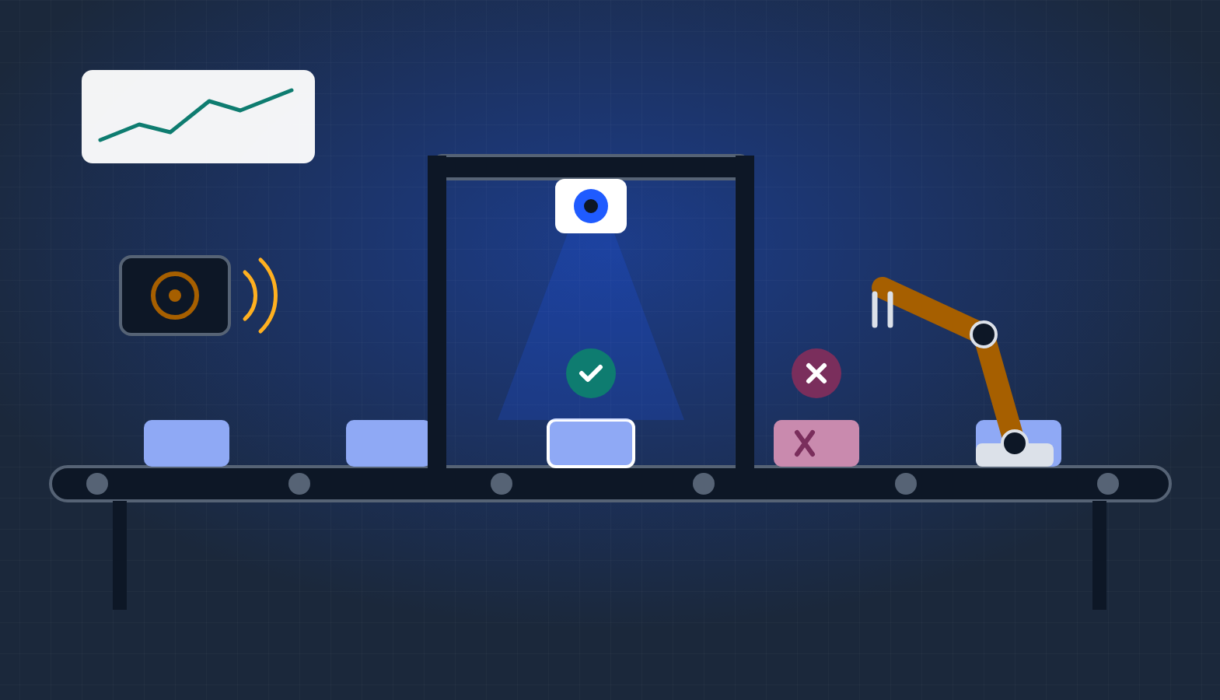
- A camera photographs every part as it passes
- An AI computer beside the line checks the image in under 15 milliseconds
- Faulty parts are pushed off the line automatically
- The machine is told to adjust, so the fault stops at its source
Why older camera systems fell short
Automated camera inspection isn't new. Systems from the 1990s and 2000s used fixed rules — look for edges, measure distances, compare against a template [5]. That's great for simple measurements, like checking the gap between two drilled holes.
But rule-based systems struggle with the real world. A change in sunlight, natural variation in metal grain, a bit of oil or a shiny reflection could push false rejects to 15–25%. And they couldn't tell a harmless smudge from a dangerous crack.
Instead of hand-written rules, modern systems learn from examples [6, 7]. Because real defects are rare, many are trained only on thousands of good parts. They learn what "normal" looks like, so anything different — a scratch, a speck of debris, a bad solder joint — stands out, even if the AI has never seen that exact defect before [8].
What it takes to run AI inspection on a fast line
Production lines can move 300 to 1,200 parts per minute, so each check must finish in about 15–30 milliseconds. Sending images to the cloud is far too slow, so everything happens next to the line. A typical station has:
- Precise lighting — bright LED strobes timed to the conveyor, with filters to cut glare on shiny metal.
- Industrial cameras — capturing sharp, high-resolution images more than 100 times a second.
- A rugged AI computer — with a graphics processor that runs a slimmed-down version of the AI model, making it 3–6× faster without losing accuracy [9].
- A direct link to the line's controller — so a faulty part can be pushed into a reject bin within a millisecond.
Three approaches compared
Human inspectors
- Checks 1–5% of parts
- Results 30–60 minutes later
- Few false alarms
- Misses 10–35% of defects due to fatigue
- Little set-up, but ongoing labour
Traditional vision
- Checks 100% of parts
- Results in 30–100 ms
- 10–25% false alarms from lighting and shine
- Misses complex or irregular flaws
- Weeks of manual tuning
Deep learning
- Checks 100% of parts
- Results in under 15 ms
- Under 0.2% false alarms once tuned
- Misses fewer than 0.01% of defects
- Set up in hours; tells machines to self-correct
2. Fixing machines before they break
Unplanned downtime is one of the biggest drains on a factory's profits. Across manufacturing it costs an average of $260,000 an hour — and more than $2 million an hour when a car assembly line stops [10, 11].
The traditional answer is servicing machines on a fixed schedule, such as every 2,000 hours or six months. But the landmark Nowlan and Heap study found that 82% of equipment failures happen randomly and have nothing to do with a machine's age [12]. Worse, opening up healthy machines introduces new problems: up to 10% of freshly rebuilt equipment fails within 48 hours of restarting.
Predictive maintenance flips the logic: service a machine when the data says it needs it — not when the calendar does.
The early warning signs
A failing part gives off signals long before it breaks. The earlier you can detect them, the more time you have to plan a repair:
- Ultrasonic sound (too high for humans to hear): 60–90 days before failure
- High-frequency vibration: 30–60 days before
- Changes in the motor's electrical current: 14–30 days before
- Hot spots (seen with thermal cameras): 3–7 days before
- Audible noise or smoke: 24–48 hours before — usually too late
Three types of sensor that do the listening
Vibration
Small sensors bolted to motors, pumps, gearboxes and spindles measure shaking in three directions, thousands of times a second [13]. Each type of bearing damage creates its own vibration "fingerprint", so the AI can tell exactly which part is wearing.
Ultrasonic sound
Tiny cracks and failing lubrication create high-pitched sound (20–100 kHz) long before they cause vibration or heat [14]. Because factory noise is mostly at lower pitches, these sensors can pick up the warning signs even on a loud shop floor.
Motor current
Clip-on sensors in the electrical cabinet read the power flowing to a motor. Problems in the motor or the machine it drives show up as tiny changes in that current [15] — so machines in hot, wet or hazardous places can be monitored without putting sensors on them.
From raw data to "replace this part next weekend"
A single machine can generate nearly 77,000 sensor readings per second — too much to send to the cloud. So a small computer beside the machine turns the readings into images of sound and vibration patterns, and AI scans them for anything unusual. When it finds early wear, it forecasts how much useful life the part has left, using well-established engineering models of how metal fatigue cracks grow [16]. That lets the maintenance team replace the part during a planned weekend shift, instead of facing an emergency shutdown.
3. Schedules that rewrite themselves
Most factories plan production once a week or once a day. Those plans assume every machine works perfectly, every job takes the expected time and energy prices stay the same. Reality is messier:
- A milling machine overheats and shuts down.
- A delivery of steel is harder than usual, so cutting has to slow down by 12%.
- A customer suddenly adds 500 rush units.
- The power company triples electricity prices for the next three hours.
When that happens, the plan falls apart and supervisors fall back on whiteboards, spreadsheets and gut feel. The result: piles of half-finished work, idle machines and missed deadlines.
Why scheduling is so hard
Deciding which job goes on which machine, and in what order, is one of the hardest problems in mathematics [17]. In a plant with 50 machines, 12 robotic cells and 200 open orders, there are more possible schedules than atoms in the universe — far too many for traditional planning software to re-check whenever something changes.
How AI handles it
Leading manufacturers train AI scheduling agents in a virtual copy of the factory (a digital twin), where they practise millions of scenarios [18]. Once deployed, the agent watches the real line and makes new dispatch decisions in under a second — for example, sending the next job to Machine 4 instead of Machine 2. It balances several goals at once:
- Cheaper energy. Power-hungry ovens, furnaces and presses are shifted to times when electricity is cheap — such as sunny middays or windy nights — cutting electricity costs by 10–18%, and up to 22% in very energy-intensive plants, without delaying deliveries [19].
- Protecting worn machines. If sensors show a bearing starting to wear, the scheduler gives that machine lighter work and moves heavy jobs elsewhere, keeping it running safely until its planned repair.
4. Results from real factories
The case for AI in manufacturing isn't theoretical. Benchmarks from McKinsey, ARC Advisory Group and the World Economic Forum show consistent results:
30–50%
less unplanned downtime
20–40%
lower scrap and rework costs
+8–16 pts
overall equipment effectiveness (OEE)
+5–12%
more output from the same line
10–18%
lower energy use
6–14 months
typical payback period
OEE (overall equipment effectiveness) is the standard measure of how productive a line is — combining how often it runs, how fast, and how many good parts it makes.
Four case studies
BMW Group
At its Regensburg (Germany) and Spartanburg (US) plants, BMW uses AI cameras inside stamping presses — which make over 10,000 body parts a day — to spot tiny tears and cracks. Robot welding cells use cameras and sound sensors to check every weld as it's made [20].
- 28% less rework in the body shop
- 70% fewer false rejects on painted bodies
- Paid for itself in 8.5 months
TSMC & Foxconn
Chip factories use AI to estimate the quality of every wafer from sensor data, instead of slowly measuring a few test wafers under a microscope [21]. Foxconn's phone-board lines place over 100,000 tiny components an hour, with AI checking each solder joint in under 10 milliseconds.
- First-pass yield up from 97.4% to 99.2%
- About $14 million a year saved per high-volume line
- Fewer than 5 defects per million reach final testing
ArcelorMittal
The steelmaker fitted vibration and ultrasonic sensors to the huge gearboxes and motors on its rolling mills. AI also schedules its electric furnaces — which use tens of megawatts — around hourly electricity prices [22].
- Major gearbox failures cut from 3.2 a year to zero
- More than 60 hours of plant shutdowns avoided
- Energy cost per ton down 14.2% — over €6.5 million saved a year
Unilever
On high-speed bottling lines, short jams lasting seconds add up fast. Unilever added sound and motor-current sensors, plus 360° cameras checking seals, caps and fill levels at 800 bottles a minute [23].
- 41% fewer line stoppages
- OEE up from 68.5% to 79.8%
- 84% fewer customer quality complaints within six months
5. Connecting factory machines safely
Putting AI into a factory is very different from rolling out office software. The shop floor has strict safety rules, lots of old equipment and serious security risks.
Working with older machines
Fewer than 10% of factories were built from scratch for digital connectivity. Most run machines that are 15–30 years old, controlled by equipment that speaks outdated or proprietary languages [24].
Rather than reprogramming those controllers — which could break proven processes or safety certifications — engineers add separate sensors (magnetic vibration pads, clip-on current sensors, standalone cameras). Rugged gateways then read data from the old equipment and translate it into modern, open standards such as OPC UA [25] and MQTT Sparkplug B [26].
- Business systems — company-wide planning software, long-term data storage and AI model training
- Plant operations — factory control servers, data historians and the scheduling engine
- Edge AI — computers beside the line running real-time vision and sound analysis
- Machine controllers — the controllers that run robots and machines
- The physical process — tools, conveyors, cameras and sensors
Security and safety come first
Connecting machines creates new ways for attackers to get in. Attacks such as Stuxnet and Triton, and ransomware hitting factories, have shown that hacking industrial systems can cause physical damage, injuries or environmental harm [27]. Industrial AI should follow the IEC 62443 security standard:
- Keep networks separated. The AI computers on the factory floor must never be reachable directly from the office network or the internet. All data passes through a protected buffer zone with firewalls.
- Verify every device. Every sensor, gateway and server must prove its identity and use encrypted connections, with security keys stored in tamper-resistant hardware.
- AI never overrides safety. Emergency stops, safety light curtains and overload cut-offs must stay hard-wired to dedicated safety controllers that can shut machines down no matter what the software says.
6. A four-stage plan to get started
Big, all-at-once "digital transformation" projects often fail. The plants that succeed start small and focus on the problems that cost the most.
Find the biggest problems
Rank machines by how much their breakdowns cost: hourly cost of a stoppage × how often it fails × how long repairs take. Work out which parts fail, why, and which signal (vibration, sound or current) would warn first. Find the station that creates the most scrap, and record today's OEE as a baseline.
Add sensors and connections
Fit vibration sensors on critical bearings, sound sensors on hydraulics and current sensors in motor cabinets. Mount cameras and lighting over the target line. Install rugged computers next to the line and stream the data to an on-site database.
Train and test in "shadow mode"
Train the AI models and optimise them to run in under 15 milliseconds. Then run them alongside existing inspectors and maintenance schedules for 60–90 days without letting them act. Compare every AI call with what actually happened, and tune until false rejects are below 0.2% and missed defects below 0.01%.
Let the AI take action
Connect the cameras to the line so faulty parts are removed automatically. Link maintenance alerts to your maintenance software (such as SAP PM or IBM Maximo) so it can raise a work order, reserve the spare part and book a technician. Finally, switch on AI scheduling that accounts for machine health and energy prices.
Five lessons for factory leaders
- Check everything, not a sample. With zero-defect expectations, batch sampling is outdated. AI cameras can inspect every part at full speed and catch problems where they start.
- Listen for the earliest warnings. Don't wait for vibration or heat. Ultrasonic sensors can detect wear 60–90 days before failure, giving teams time to plan repairs.
- Keep real-time decisions on site. Use the cloud for training models and company-wide reporting, but run time-critical AI on computers beside the line.
- Never compromise on safety. Follow IEC 62443, keep factory networks isolated, and make sure certified, hard-wired emergency stops can never be bypassed by AI.
- Start with your costliest bottleneck. Skip the multi-year master plan. Pick one critical machine or high-scrap line, prove payback within 6–12 months, earn the trust of operators and technicians, then expand.
Sources
Every figure in this article comes from the sources below.
- Schwab, K. (2016). The Fourth Industrial Revolution. World Economic Forum / Crown Business.
- Plattform Industrie 4.0 & BMWK (2019/2022). "Reference Architecture Model Industrie 4.0 (RAMI 4.0)" and "Details of the Asset Administration Shell (IEC 63278)."
- ISO 2859-1 (2011/2020). Sampling procedures for inspection by attributes; Montgomery, D. C. (2019). Introduction to Statistical Quality Control, 8th ed. Wiley.
- Drury, C. G. & Fox, J. G. (1975/2014). Human Reliability in Quality Control. Taylor & Francis; See, J. E. (2012). "Visual inspection: A review of the literature." Sandia National Laboratories, SAND2012-8590.
- Bradski, G. & Kaehler, A. (2008). Learning OpenCV. O'Reilly Media.
- Dosovitskiy, A. et al. (2021). "An Image is Worth 16×16 Words: Transformers for Image Recognition at Scale." ICLR.
- Jocher, G., Chaurasia, A. & Qiu, J. (2023). Ultralytics YOLOv8 documentation; Bochkovskiy, A., Wang, C.-Y. & Liao, H.-Y. M. (2020). "YOLOv4." arXiv:2004.10934.
- Bergmann, P. et al. (2021). "The MVTec Anomaly Detection Dataset." International Journal of Computer Vision 129(4), 1038–1059.
- NVIDIA (2023/2024). TensorRT 8.6 Developer Guide.
- Aberdeen Group (2016/2020). "The Cumulative Cost of Unplanned Downtime in Industrial Manufacturing."
- Siemens AG (2022). "The True Cost of Downtime." Senseye white paper.
- Nowlan, F. S. & Heap, H. F. (1978). "Reliability-Centered Maintenance." US Department of Defense, AD-A066579.
- ISO 20816-1 (2016/2021). Mechanical vibration — Measurement and evaluation of machine vibration.
- Mba, D. & Hall, L. D. (2002). "Condition monitoring of low-speed rotating machinery using stress waves: A review." Proc. IMechE Part E 216(1), 63–76.
- Thomson, W. T. & Fenger, M. (2001). "Current signature analysis to detect induction motor faults." IEEE Industry Applications Magazine 7(4), 26–34.
- Paris, P. C., Gomez, M. P. & Anderson, W. E. (1961). "A rational analytic theory of fatigue." The Trend in Engineering 13(1), 9–14; Weibull, W. (1951). Journal of Applied Mechanics 18(3), 293–297.
- Garey, M. R., Johnson, D. S. & Sethi, R. (1976). "The complexity of flowshop and jobshop scheduling." Mathematics of Operations Research 1(2), 117–129.
- Zhang, C. et al. (2020). "Learning to Dispatch for Job Shop Scheduling via Deep Reinforcement Learning." NeurIPS 33, 1621–1632.
- US Department of Energy, EERE (2021). "Industrial Energy Management through Dynamic Demand Response and AI-Driven Load Shifting."
- BMW Group (2021/2023). "AI in the BMW Group Production System: Regensburg and Spartanburg."
- Moyne, J. & Iskandar, J. (2017). "Big Data Analytics for Semiconductor Manufacturing." IEEE Transactions on Semiconductor Manufacturing 30(4), 317–328.
- ArcelorMittal Global R&D (2021/2022). "Digital Transformation in Steel Manufacturing."
- Unilever & World Economic Forum Global Lighthouse Network (2021/2023). "Unilever Dubai Personal Care Factory."
- Williams, T. J. et al. (1994). "The Purdue Enterprise Reference Architecture."
- OPC Foundation / IEC (2020). IEC 62541: OPC Unified Architecture.
- Eclipse Foundation & Cirrus Link (2019/2022). Sparkplug B: MQTT Topic & Payload Definition.
- IEC (2018/2021). IEC 62443: Security for industrial automation and control systems.