
Will Automation Eliminate Jobs or Transform Them?

Every wave of new technology brings the same worry: this time, the machines will take the jobs. So far, history has mostly proved the pessimists wrong — total employment has kept growing, and most of today's jobs didn't exist a few generations ago. But that long-run story hides real pain for the people and places whose work disappears. Here's what the evidence says about automation and jobs, what's different about AI, and how the transition can be made fairer.
- About 60% of US jobs in 2018 were in types of work that didn't exist in 1940. New technology has created as well as destroyed work.
- Automation does three things at once: it replaces some tasks, helps with others and creates entirely new ones.
- The losses are real and concentrated. In the US, areas that adopted more industrial robots saw lower employment and wages.
- AI reaches office work that earlier automation couldn't. Even so, global estimates point to transformation far more than wholesale job loss.
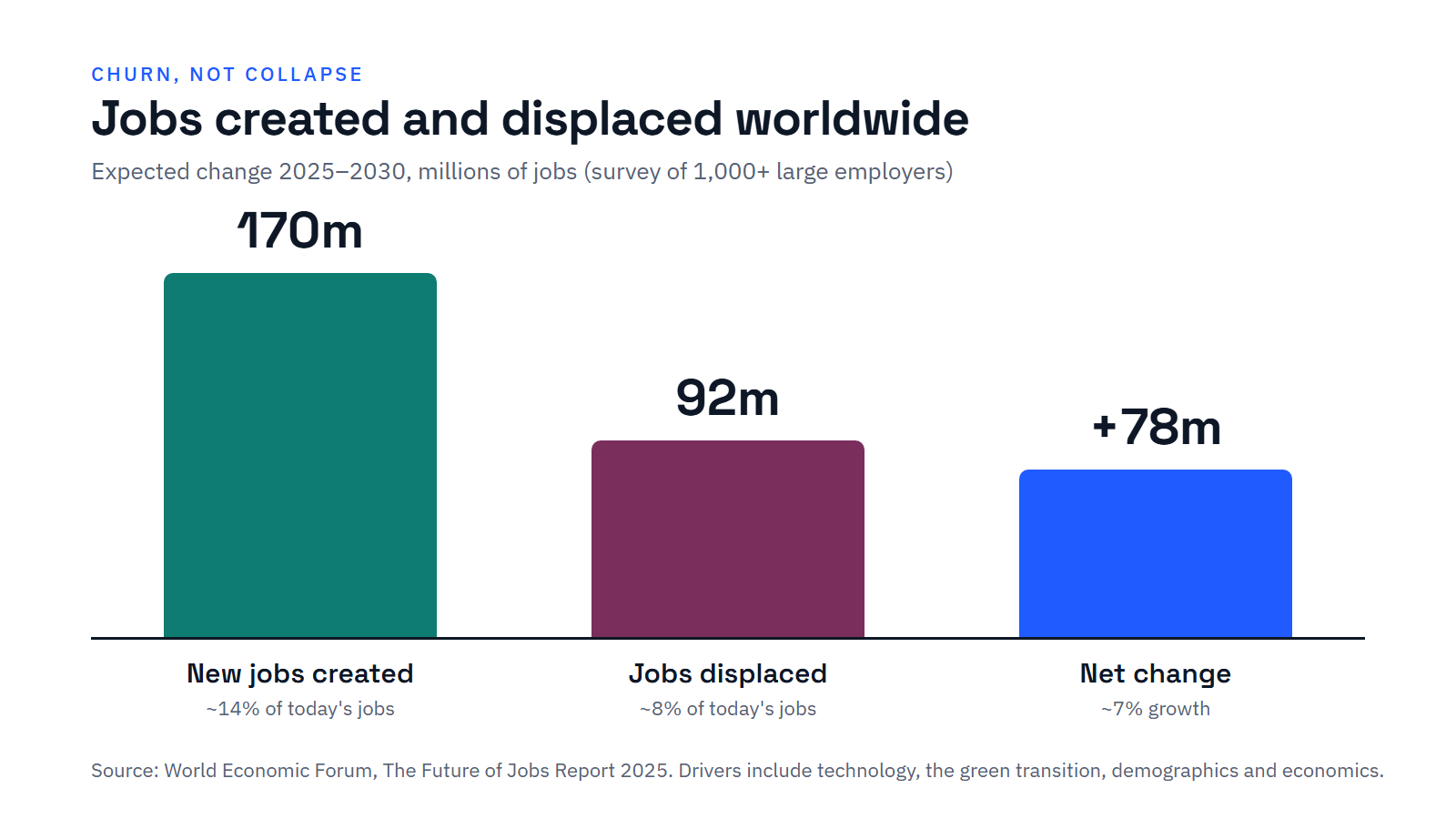
- Employers surveyed by the WEF expect 170 million jobs to be created and 92 million displaced by 2030. Managing that churn is the real challenge.
An old fear with a mixed record
In the early 1800s, English textile workers known as the Luddites smashed the machines they feared would replace them. In 1930, the economist John Maynard Keynes warned of "technological unemployment". In the 1960s, the US government set up a national commission to study whether automation would cause mass joblessness. Each time, employment kept growing over the following decades.
Research by MIT economist David Autor and colleagues helps explain why. Using job titles from US census records spanning eight decades, they found that around 60% of employment in 2018 was in types of work that didn't exist in 1940 — from software developers to fitness instructors [1]. Technology destroyed many jobs, but it also helped create entirely new ones.
Three things automation does at once
Economists Daron Acemoglu and Pascual Restrepo describe technology as having competing effects: it can push people out of tasks they used to do, and it can create new tasks where humans are needed [2]. In practice, automation does three things at once:
Replaces tasks
Machines take over work people used to do: switchboard operators, typing pools, assembly-line welding, ticket sales.
Makes people more productive
Tools help workers do more and better: spreadsheets for accountants, imaging for doctors, design software for architects.
Creates new work
Entirely new jobs and industries appear: web developers, data analysts, app designers, cybersecurity specialists, drone pilots.
Whether automation is good or bad for jobs depends on the balance: does it create new work, and raise productivity, faster than it replaces existing work? That balance isn't fixed — it depends on how technology is designed and used.
The losses are real — and concentrated
The long-run picture doesn't mean nobody loses. Acemoglu and Restrepo studied the spread of industrial robots in the US between 1990 and 2007. They found that one additional robot per thousand workers reduced the employment-to-population ratio by about 0.2 percentage points and wages by about 0.42% in affected local labour markets [3]. Manufacturing towns took the biggest hit.
Autor's research also found that automation has eroded more work since 1980 than in the four decades before, while new jobs have increasingly been created at the top and bottom of the pay scale — high-paid professional roles and lower-paid services — rather than in the middle [1].
Economies adapt to automation over decades. Individual workers have to adapt within months.
Is AI different?
Earlier automation mostly replaced physical and routine tasks. AI can also draft text, analyse data and write code — tasks done by office and professional workers. That widens the range of jobs affected.
27%
of jobs in OECD countries are in occupations at highest risk of automation [4]
25%
of jobs worldwide are exposed to generative AI [5]
3.3%
of jobs are in the highest generative-AI exposure group [5]
But exposure isn't the same as elimination. The OECD found the occupations at highest risk of automation are mostly in low- and middle-skill work, and at the time saw little evidence that AI was reducing employment overall [4]. The ILO's 2025 global index concluded that most exposed jobs are likely to be transformed rather than replaced [5].
The outlook: churn, not collapse
The World Economic Forum's Future of Jobs Report 2025, based on a survey of more than 1,000 large employers, expects 170 million new jobs and 92 million displaced jobs between 2025 and 2030 — a net gain of 78 million [6]. These figures include the effects of the green transition, demographic change and economic conditions as well as technology.
- Big data specialists
- Fintech engineers
- AI and machine learning specialists
- Software developers
- And in absolute numbers: farmworkers, delivery drivers, construction workers, care workers and teachers
- Cashiers and ticket clerks
- Administrative assistants and secretaries
- Bank tellers
- Data entry clerks
- Printing workers
The transition is the hard part
Even when new jobs outnumber lost ones, they often appear in different places, require different skills and pay differently. A displaced bank teller in a small town doesn't automatically become a data scientist in a big city. Older workers and those with fewer qualifications typically find it hardest to move into new roles.
That's why the question "Will automation eliminate jobs?" is less useful than "Who bears the cost of the transition, and who gets the benefits?" The answer depends on choices made by employers, governments and workers.
What helps
- Early warning. Employers who plan automation openly give workers time to retrain and move into new roles.
- Retraining that leads to real jobs. The most effective programmes are linked to specific employers and skills in demand.
- Support between jobs. Income support, job search help and portable benefits reduce the cost of moving between roles.
- Technology that complements people. Choosing tools that make workers more capable — not just cheaper to replace — widens the gains.
- Local investment. Places hit hard by automation need new industries, not just retraining courses.
The bottom line
Automation has never simply eliminated work — but it has always changed who does what, where and for how much. AI is likely to follow the same pattern, reaching further into office work and moving faster. Whether it turns out to be a story of transformation or of hardship depends less on the technology itself than on how well societies manage the transition.
Sources
Every figure in this article comes from the sources below.
- Autor, D., Chin, C., Salomons, A. & Seegmiller, B. (2024). "New Frontiers: The Origins and Content of New Work, 1940–2018." The Quarterly Journal of Economics 139(3). DOI: 10.1093/qje/qjae008.
- Acemoglu, D. & Restrepo, P. (2019). "Automation and New Tasks: How Technology Displaces and Reinstates Labor." Journal of Economic Perspectives 33(2), 3–30.
- Acemoglu, D. & Restrepo, P. (2020). "Robots and Jobs: Evidence from US Labor Markets." Journal of Political Economy 128(6), 2188–2244.
- OECD (2023). OECD Employment Outlook 2023: Artificial Intelligence and the Labour Market.
- Gmyrek, P. et al. (2025). Generative AI and Jobs: A Refined Global Index of Occupational Exposure. ILO Working Paper 140.
- World Economic Forum (2025). The Future of Jobs Report 2025.