
How Education Must Adapt to an AI-Driven Economy
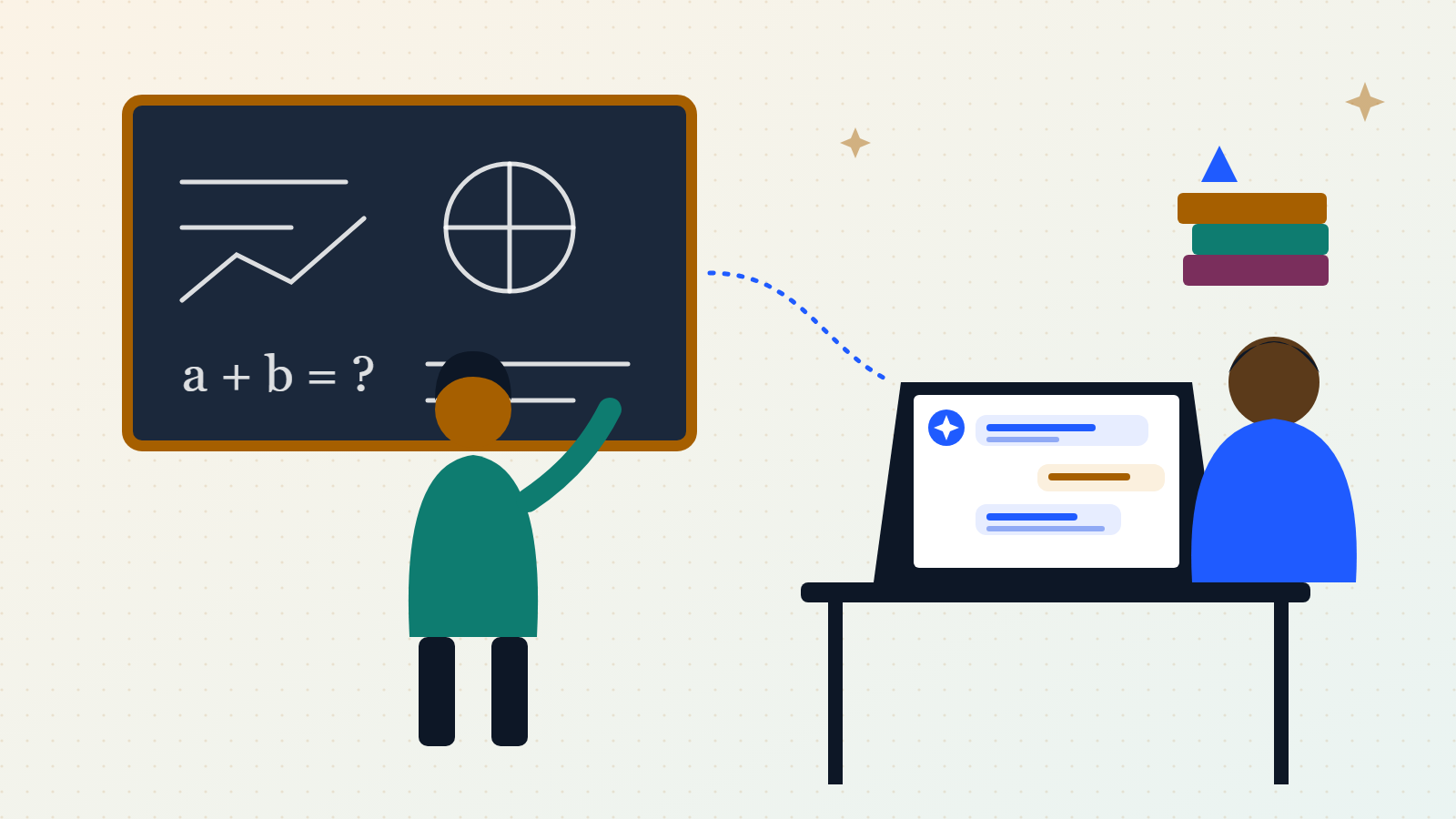
Students adopted AI before most schools had a plan for it. Now education systems face two challenges at once: deciding how AI should be used in classrooms, and preparing young people and adults for a labour market that AI is reshaping. The early evidence shows AI can be a powerful learning aid — when teachers stay in charge. Here's what's changing, what the research says, and what schools, universities, employers and governments need to do.
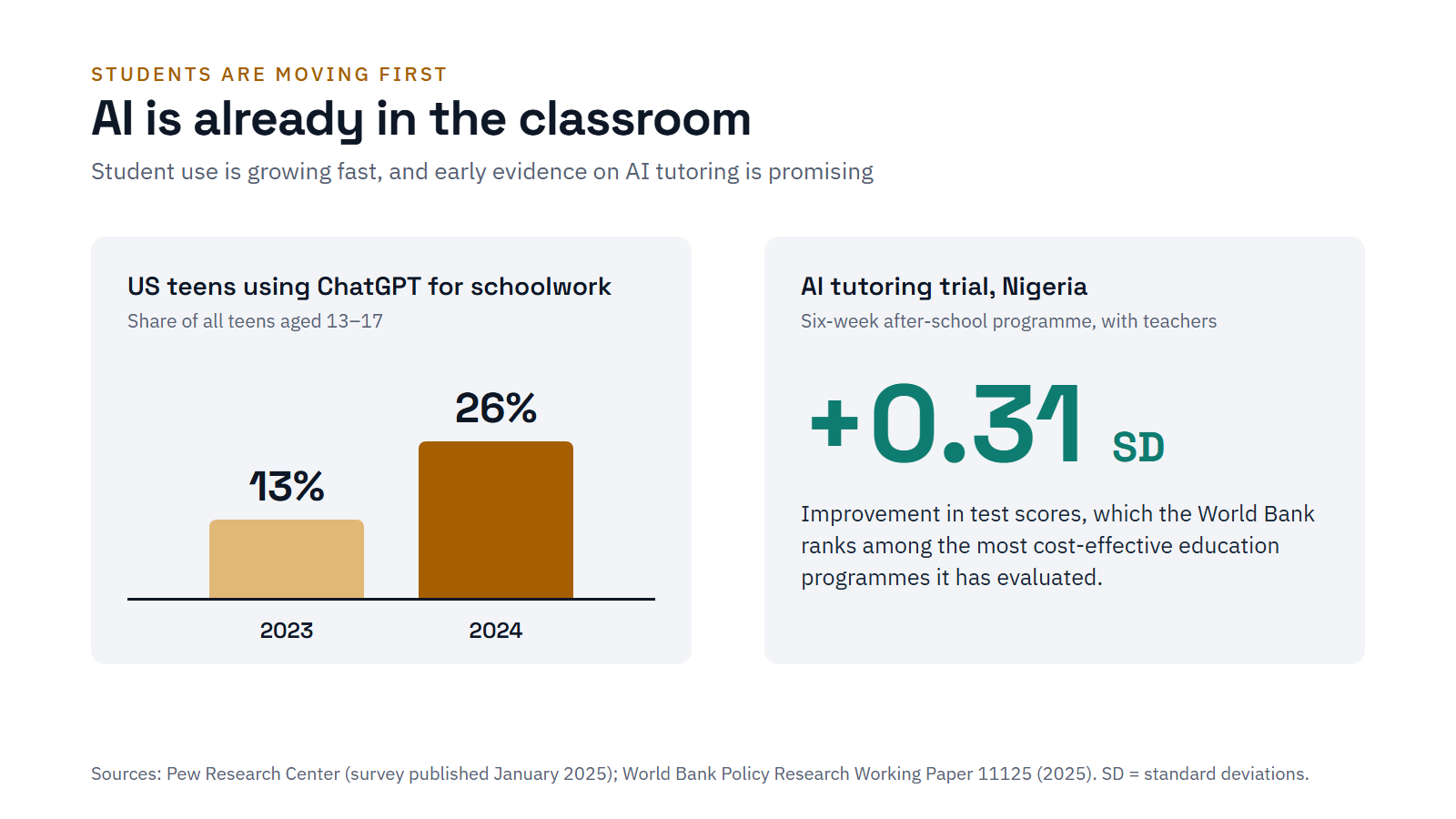
- The share of US teens using ChatGPT for schoolwork doubled from 13% in 2023 to 26% in 2024.
- In 2023, fewer than 10% of schools and universities surveyed by UNESCO had formal guidance on generative AI.
- Well-designed AI tutoring can work: a World Bank trial in Nigeria raised test scores by 0.31 standard deviations in six weeks, with teachers guiding students.
- The biggest risks are over-reliance, cheating, inaccurate answers, privacy and a widening digital divide.
- Education must change what it teaches, how it assesses and how it supports adults to keep learning throughout their careers.
Students got there first
Generative AI arrived in classrooms through students' phones rather than school policies. A Pew Research Center survey found that the share of US teens aged 13 to 17 who had used ChatGPT for schoolwork doubled from 13% in 2023 to 26% in 2024 [1].
Institutions were slower. A UNESCO survey of around 450 schools and universities in 2023 found that fewer than 10% had formal policies or guidance on generative AI — 13% of universities and just 7% of schools [2]. UNESCO has since published guidance urging governments to regulate AI in education, protect students' data and set age limits for classroom use [3].
What AI can do for learning
Used well, AI can help with some of education's oldest problems: large classes, overstretched teachers and students who need more individual support.
One-to-one support at scale
In a World Bank randomised trial in Nigeria, a six-week after-school programme using an AI tutor alongside teachers improved test scores by 0.31 standard deviations, with the largest gains for girls [4].
Better human tutors
A Stanford study of "Tutor CoPilot" found students whose tutors had AI suggestions were 4 percentage points more likely to master topics — and 9 points more likely with less experienced tutors [5].
Less admin for teachers
Drafting lesson plans, quizzes, differentiated materials and feedback can free teachers to spend more time with students.
Support for more learners
Translation, text-to-speech and simplified explanations can help students with disabilities or who are learning in a second language.
The risks
- Learning less. If AI does the thinking, students may produce better work while understanding less.
- Cheating and assessment. Take-home essays and online tests are easy to complete with AI, and AI-detection tools are unreliable.
- Wrong answers. AI can state errors confidently, which is risky for learners who can't yet spot them.
- Privacy. Students' data needs strong protection, especially for children.
- Inequality. Students without devices, internet access or AI-savvy teachers risk falling further behind.
The evidence so far points to the same lesson: AI works best as a teacher's assistant, not a teacher's replacement.
Why it matters for the economy
The pressure on education doesn't stop at school. The World Economic Forum's Future of Jobs Report 2025 estimates that 39% of workers' core skills will change by 2030, and that if the world's workforce were 100 people, 59 would need training by then [6]. That makes lifelong learning — not just a degree at the start of a career — an economic necessity.
AI literacy means understanding what AI can and can't do, how to use it well, how to check its output and how to use it responsibly. It's becoming as basic as knowing how to search the web or use a spreadsheet.
Six things education needs to change
Adapting to AI isn't about adding a single course. It touches what is taught, how it's assessed and who gets to keep learning:
Teach AI literacy
Help students understand how AI works, where it fails and how to use it ethically — across subjects, not just computing.
Protect the basics
Reading, writing, maths and subject knowledge still matter — they're what let people judge whether AI is right.
Rethink how learning is tested
Use more in-class work, oral exams, projects and assessment of the process, not just the final product.
Train and support staff
Teachers need time, training and clear guidance to use AI confidently and to teach students to use it well.
Make adult learning easier
Short courses, micro-credentials and flexible study help working adults reskill as their jobs change.
Close the access gap
Devices, connectivity and approved AI tools for every student, so AI narrows rather than widens inequality.
Who needs to act
- Schools should set clear, practical rules on when AI is allowed, and teach students to use it critically.
- Universities need to update courses and assessment, and prepare graduates to work alongside AI in their fields.
- Employers can partner with colleges on training and recognise skills gained outside traditional degrees.
- Governments should fund teacher training, ensure fair access to technology and set standards for student data protection.
- Learners of every age benefit from treating AI as a tool to understand more, not a shortcut to do less.
What to watch next
- Larger, longer AI tutoring trials to see whether early gains last.
- National AI curricula and how quickly they reach classrooms.
- Changes to exams as schools and universities adapt assessment.
- Teacher training budgets — the clearest sign of whether policies are serious.
- Skills-based hiring that values what people can do over where they studied.
Sources
Every figure in this article comes from the sources below.
- Pew Research Center (January 2025). Survey of US teens on using ChatGPT for schoolwork.
- UNESCO (June 2023). Global survey of schools and universities on generative AI guidance.
- UNESCO (2023). Guidance for generative AI in education and research.
- De Simone, M. et al. (2025). "From Chalkboards to Chatbots: Evaluating the Impact of Generative AI on Learning Outcomes in Nigeria." World Bank Policy Research Working Paper 11125.
- Wang, R. E. et al. (2024). "Tutor CoPilot: A Human-AI Approach for Scaling Real-Time Expertise." Stanford University; arXiv:2410.03017.
- World Economic Forum (2025). The Future of Jobs Report 2025.