
The Skills Workers May Need in the Next Decade
Most of us will change jobs, tools and ways of working several times over a career — and AI is speeding that up. Employers expect a large share of today's skills to change by the end of the decade. The good news is that the most valuable skills aren't only technical: creativity, judgement, communication and the ability to keep learning are rising in importance too. Here's what the evidence says about the skills workers will need, and how to build them.
- Employers surveyed by the World Economic Forum expect 39% of workers' core skills to change by 2030.
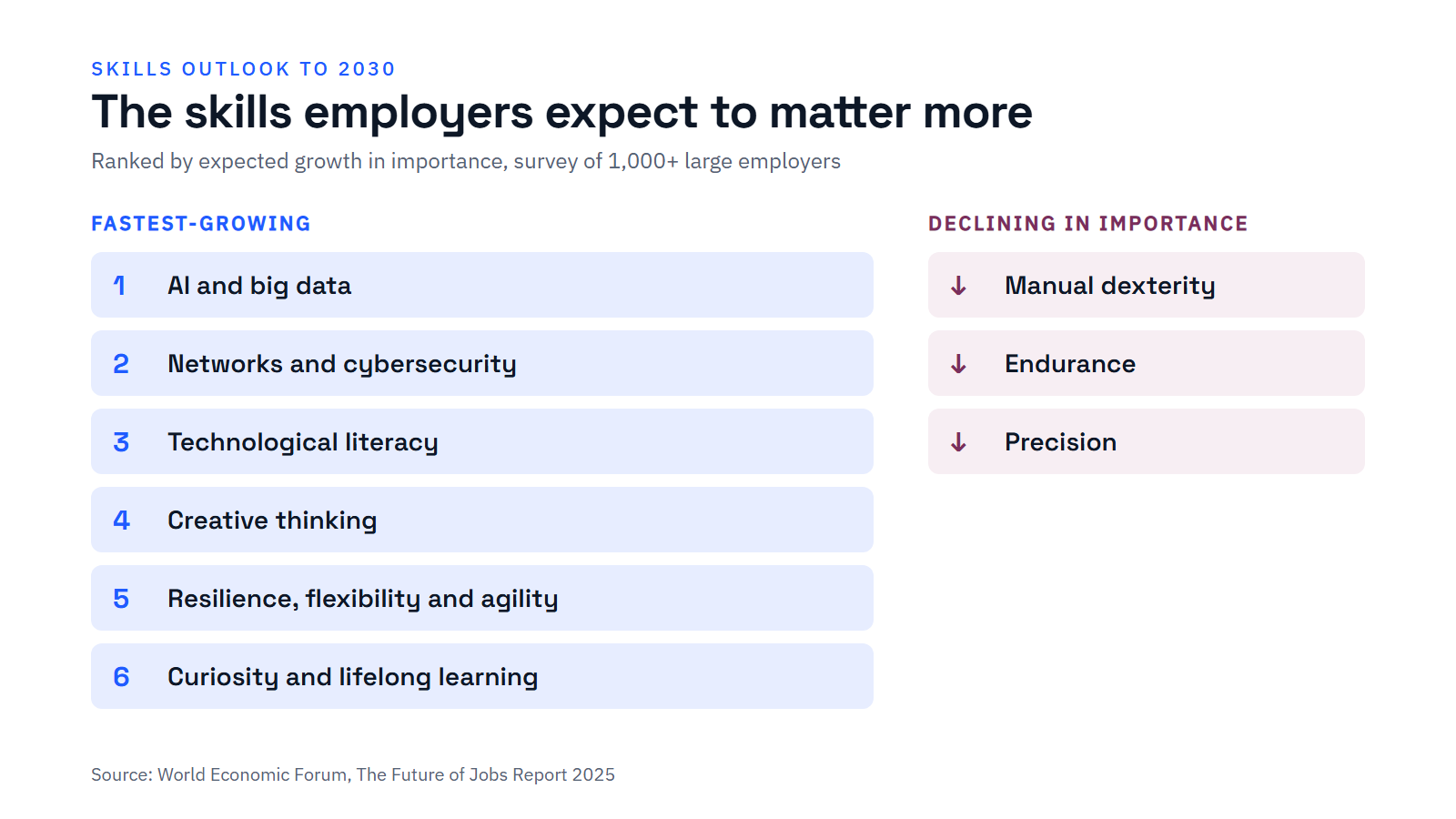
- The fastest-growing skills are AI and big data, networks and cybersecurity, and technological literacy, followed by creative thinking, resilience and curiosity.
- LinkedIn data shows the skills needed for the average job have already changed by about 25% since 2015.
- Human skills such as judgement, communication and leadership become more valuable as AI handles routine tasks.
- Learning how to learn may be the most important skill of all.
How fast skills are changing
Skills have always evolved, but the pace is quickening. The World Economic Forum's Future of Jobs Report 2025, based on a survey of more than 1,000 large employers, estimates that 39% of workers' core skills will change by 2030 [1]. LinkedIn's data shows the skills needed for the average job have changed by around 25% since 2015, and LinkedIn expects that figure to reach at least 65% by 2030 as AI spreads [2].
39%
of core skills expected to change by 2030 [1]
59 in 100
workers will need training by 2030 [1]
85%
of employers plan to prioritise upskilling their workforce [1]
The WEF puts it simply: if the world's workforce were 100 people, 59 would need some training by 2030. Most could be upskilled in their current roles or redeployed, but some risk being left behind if training doesn't reach them [1].
Three families of skills
The skills rising in importance fall into three broad groups. Most jobs will need a mix of all three:
Working with technology
- AI and data literacy
- Networks and cybersecurity awareness
- General technological literacy
- Specialist skills for your field
Working with people
- Creative and analytical thinking
- Communication and persuasion
- Leadership and social influence
- Empathy and active listening
Managing yourself
- Resilience, flexibility and agility
- Curiosity and lifelong learning
- Motivation and self-awareness
- Managing your own time and attention
Why human skills are gaining value
As AI takes on routine drafting, summarising and data processing, the parts of work it can't do become more important: deciding what matters, persuading others, handling sensitive situations, and taking responsibility for results. (We explore this in more detail in How AI Is Changing the Workplace — and What It Leaves Unchanged.) At the same time, the WEF finds that skills like manual dexterity, endurance and precision are expected to decline in importance, as machines take on more physical tasks [1].
The more capable AI becomes, the more valuable it is to know what to ask it, when to trust it and when to overrule it.
AI literacy: the new baseline
Just as basic computer skills became essential in the 1990s, a working understanding of AI is becoming a baseline skill across most jobs. It doesn't mean learning to code. It means:
- Knowing what AI is good and bad at — and which tasks to keep for yourself.
- Asking clearly — giving AI tools good instructions, context and examples.
- Checking the output — spotting errors, made-up facts and bias.
- Protecting data — knowing what information should never go into an AI tool.
- Using it responsibly — being honest about when AI was used, and respecting others' work.
What it means for different jobs
The mix of skills that matters most varies by role. Some typical examples:
Using AI tools confidently, managing data accurately, and moving towards coordination, customer contact and problem-solving.
Working with connected equipment, diagnostics and digital records, plus customer service and safety skills.
Redesigning work around AI, coaching people through change, and making sound judgements on AI-assisted decisions.
Keeping up with fast-changing tools, plus explaining technical work clearly to non-specialists.
How to build these skills
- Try AI tools on low-risk tasks at work and at home.
- Take short, focused courses rather than waiting for a big qualification.
- Ask for projects that stretch you into new areas.
- Learn from colleagues: teaching others is one of the best ways to learn.
- Keep a record of new skills to show employers.
- Give staff time and budget for learning, not just access to courses.
- Map the skills each role will need over the next few years.
- Hire for skills and potential, not only degrees and job titles.
- Build learning into everyday work through coaching and projects.
- Pay particular attention to workers in roles most affected by AI.
Schools and universities have a big role too. For more, see How Education Must Adapt to an AI-Driven Economy.
What to watch next
- Skills-based hiring, and whether employers really drop degree requirements.
- Short credentials such as micro-credentials and industry certificates gaining recognition.
- Who gets trained — whether training reaches older, part-time and lower-paid workers.
- AI tutors at work that teach skills on the job, in the flow of work.
- New occupations appearing around AI oversight, data and digital trust.
Sources
Every figure in this article comes from the sources below.
- World Economic Forum (2025). The Future of Jobs Report 2025.
- LinkedIn Economic Graph. Future of Work Report: AI at Work; LinkedIn skills-change research (2015 baseline).