

Why Data Is Becoming a Strategic Industrial Asset

Every modern machine, vehicle and building produces a constant stream of data. For years, most of it was ignored or locked away. Today it is increasingly treated like a raw material: something to be collected, cleaned, protected and turned into value — from predicting breakdowns to training AI. New laws are also changing who gets to use it. Here's why industrial data has become a strategic asset, why it's harder to use than it looks, and how organisations can get it right.
- Data from machines and products can improve operations, power new services, support better decisions and train AI.
- Data is now the main bottleneck for AI: Gartner found 63% of organisations lack, or aren't sure they have, the right data practices for AI.
- Gartner predicts organisations will abandon 60% of AI projects that aren't supported by AI-ready data through 2026.
- The EU Data Act, applicable since September 2025, gives users new rights to access and share data from connected products and machines.
- Getting value from data is mostly about ownership, quality, standards and security — not just storage.
From by-product to asset
A modern factory machine might record temperatures, vibrations, speeds and error codes thousands of times a second. Tractors log every pass across a field; lifts, trucks, wind turbines and heating systems report their status around the clock. In the past, much of this data was used only for troubleshooting, if at all. Now organisations are realising that, combined and analysed, it can reveal how equipment is really used, where waste occurs and what customers need.
Data becomes an asset when it is reliable, accessible and used to make or save money — just like a machine or a building. Raw data sitting in disconnected systems is closer to unrefined ore: potentially valuable, but not yet useful.
Four ways industrial data creates value
Organisations typically get value from data in four ways:
Run things better
Spotting machine wear before breakdowns, catching quality problems early and reducing energy use. See The Rise of AI-Powered Manufacturing.
Sell new services
Manufacturers use product data to offer maintenance contracts, uptime guarantees or pay-per-use pricing instead of one-off sales.
Decide with evidence
Forecasting demand, planning capacity and choosing where to invest, based on what's actually happening rather than guesswork.
Fuel AI
High-quality, well-labelled data is what makes AI models accurate — and proprietary data is what makes them different from competitors'.
Data is now the bottleneck for AI
As more companies invest in AI, many are discovering their data isn't ready. In a Gartner survey of more than 1,200 data management leaders, 63% said their organisations either don't have, or aren't sure they have, the right data management practices for AI. Gartner predicts that through 2026, organisations will abandon 60% of AI projects that aren't supported by AI-ready data [1].
63%
of organisations lack, or are unsure they have, AI-ready data practices [1]
60%
of AI projects without AI-ready data expected to be abandoned through 2026 [1]
$12.9m
average yearly cost of poor data quality to organisations, per Gartner [3]
Better AI starts with better data. The model is often the easy part.
Who controls industrial data?
For years, the maker of a connected machine usually controlled the data it produced — even though the customer bought and operated the machine. The EU's Data Act changes that. Since 12 September 2025, users of connected products and related services have the right to access the data they generate, and to share it with third parties such as independent repair services or competitors of the manufacturer [2].
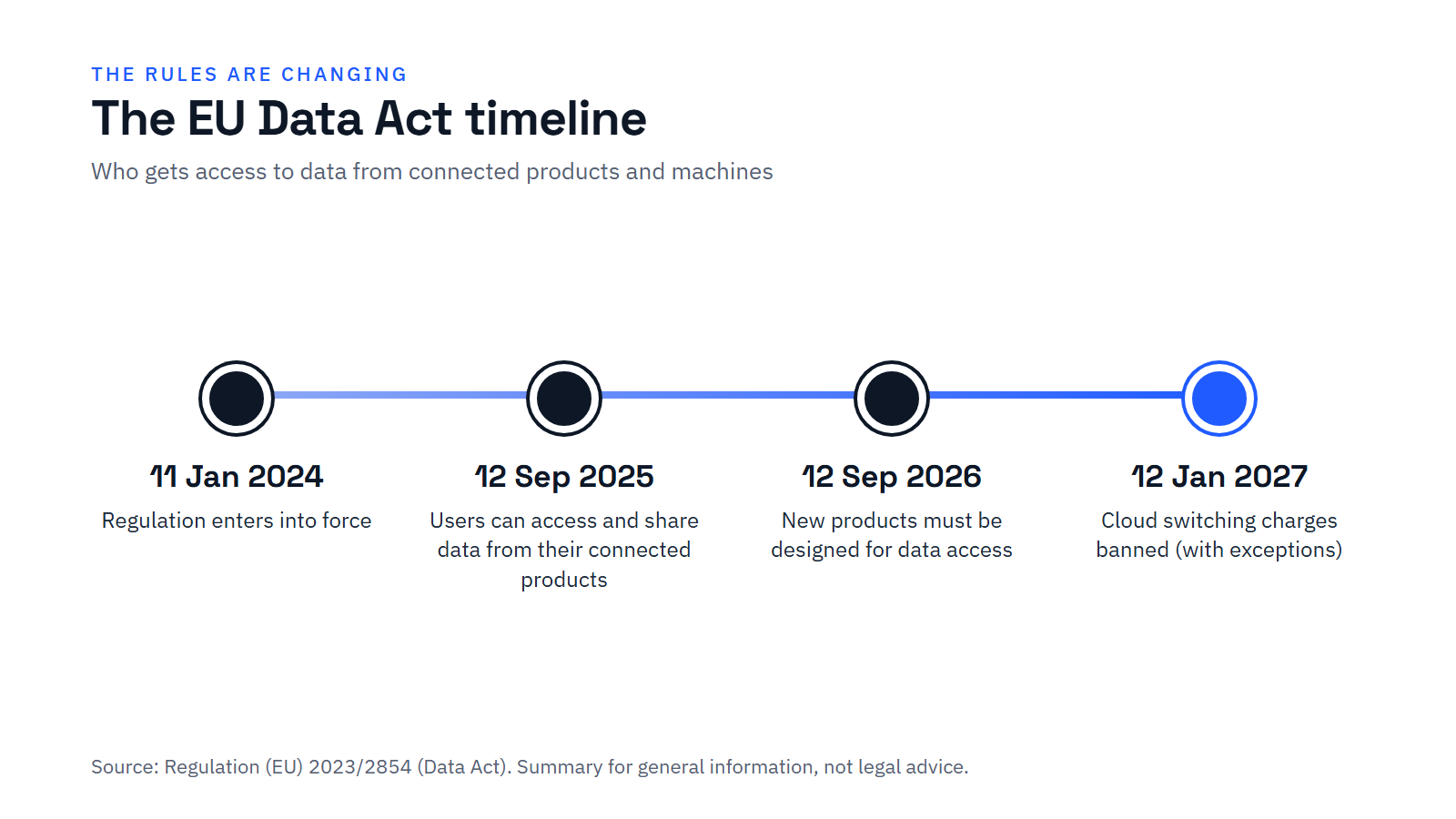
Products placed on the EU market from 12 September 2026 must be designed so users can access their data, and from January 2027 cloud providers can no longer charge customers for switching to a rival provider, with some exceptions. The rules apply to companies selling connected products in the EU wherever they are based, and include protections for trade secrets and security [2].
For manufacturers, this means data can no longer be treated as an exclusive asset simply because they built the machine. Competitive advantage will increasingly come from what companies do with data, not just from holding it.
Why data is harder to use than it looks
- Silos. Data sits in separate systems — production, maintenance, sales, finance — that don't talk to each other.
- Quality. Missing values, inconsistent labels, drifting sensors and duplicate records make results unreliable.
- Old equipment. Many machines use outdated or proprietary formats that are hard to connect.
- Ownership. Contracts with suppliers, customers and cloud providers are often unclear about who can use what.
- Skills. Data engineers and analysts are in short supply, especially outside big cities.
Building a practical data strategy
Organisations that get value from data tend to follow a few common steps:
Know what you have
Map the main data sources, where they're stored, who owns them and how good they are.
Start with a use case
Pick one valuable problem, such as unplanned downtime or scrap, and gather the data needed to solve it.
Assign owners
Make named people responsible for the quality and access rules of each key data set.
Use open standards
Open formats such as OPC UA and the Asset Administration Shell make data easier to combine and move. See Digital Twins: Moving Beyond the 3D Hype.
Protect it
Treat valuable data like any other asset: control access, encrypt sensitive data and follow a recognised security framework such as NIST CSF 2.0 [4].
Get contracts right
Spell out data access, use and sharing rights with suppliers, customers and cloud providers.
The risks of treating data as an asset
- Cyber attacks. More connected data means more targets — and industrial systems can be physically disrupted.
- Privacy. Machine data can reveal information about the people using it, such as drivers' locations or workers' performance.
- Lock-in. Proprietary platforms can make it costly to switch suppliers.
- Hoarding. Collecting data "just in case" adds cost and risk without adding value.
What to watch next
- Data Act enforcement and the first disputes over access to machine data.
- Industrial data spaces, where companies share data under common rules.
- AI-ready data becoming a standard requirement for investment decisions.
- New business models as manufacturers shift from selling products to selling outcomes.
- Data security rules for connected products under the EU's Cyber Resilience Act.
Sources
Every figure in this article comes from the sources below.
- Gartner (February 2025). "Lack of AI-Ready Data Puts AI Projects at Risk." Press release and survey of 1,203 data management leaders.
- Regulation (EU) 2023/2854 on harmonised rules on fair access to and use of data (Data Act). Official Journal of the European Union.
- Gartner (2021). "How to Improve Your Data Quality." Smarter With Gartner.
- National Institute of Standards and Technology (2024). The NIST Cybersecurity Framework (CSF) 2.0.