
How Robotics Could Change Manufacturing Work
Factories have used robots for decades, but the way people work alongside them is changing fast. Cheaper, safer and more flexible machines — including "cobots" designed to share a workbench with people — are spreading beyond big car plants into smaller manufacturers. For the people on the factory floor, that raises practical questions: which tasks will robots take on, what happens to jobs and pay, and what skills will be in demand?
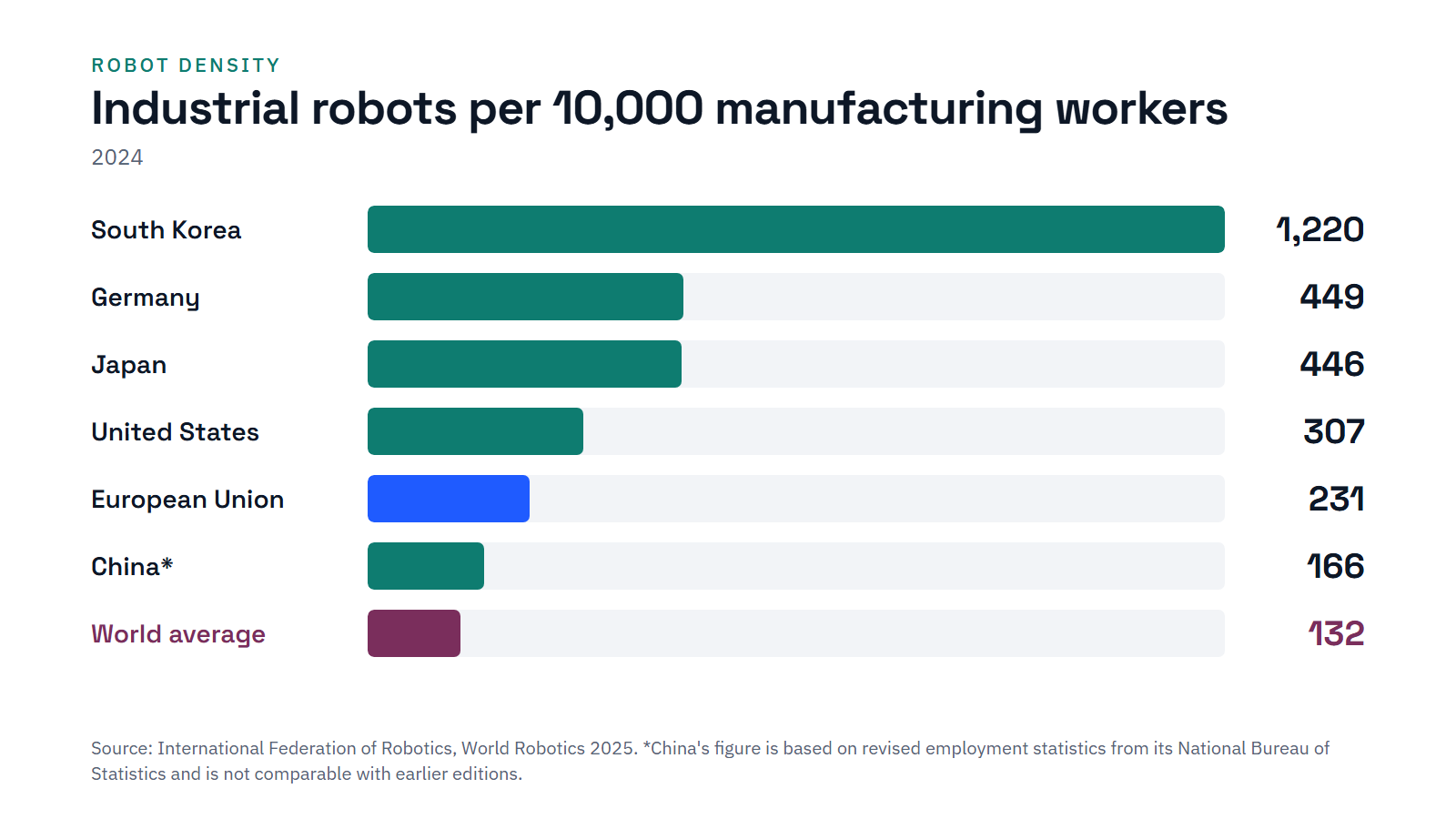
- Robot density varies hugely: South Korea has 1,220 industrial robots per 10,000 manufacturing workers, against a world average of 132.
- Robots mostly take on dull, dirty, dangerous and highly precise tasks: welding, painting, lifting and machine tending.
- Collaborative robots made up about 11% of new industrial robot installations in 2025.
- Research finds robots can reduce jobs and wages in exposed local areas, while firms that adopt them often grow and hire more. The effects depend on who adapts.
- The bigger risk for many manufacturers is a skills shortage: up to 1.9 million US manufacturing jobs could go unfilled by 2033.
How many robots are on the factory floor?
Industrial robots are at a record level. In 2025, 603,307 were installed worldwide and the global stock passed 5 million, according to the International Federation of Robotics (IFR) [1]. (For a wider look at where robots are spreading outside factories, see Why Robotics Is Moving Beyond the Factory Floor.)
But adoption is very uneven. The IFR's "robot density" measure — robots per 10,000 manufacturing employees — shows South Korea at 1,220, Germany at 449, Japan at 446 and the United States at 307, compared with an EU average of 231 and a world average of 132 [2].
What robots take on
Robots are best suited to tasks that are repetitive, physically demanding or require extreme precision — often summarised as the four Ds:
Repetitive tasks
Loading machines, packing, palletising and moving parts between stations, hour after hour.
Unpleasant environments
Painting, grinding, sanding and handling chemicals, where fumes and dust harm health.
Risk of injury
Welding, heavy lifting, foundry work and handling hot or sharp materials.
Precision work
Assembling electronics, dispensing adhesives and inspecting tiny components with consistent accuracy.
Cobots: robots that share the workbench
Traditional industrial robots work behind fences because they are fast, heavy and can't sense people nearby. Collaborative robots, or cobots, are lighter, slower and fitted with sensors that stop them on contact, so they can work next to people. The IFR reports that about 66,000 cobots were installed in 2025 — roughly 11% of all industrial robot installations [1, 3].
A cobot is a robot arm designed to work safely alongside people without a safety cage. A worker might load parts while the cobot tightens screws, or guide the arm by hand to teach it a new task. Safety rules for this kind of work are set out in standards such as ISO 10218 and ISO/TS 15066 [7].
Cobots matter for jobs because they're cheaper and easier to programme, putting automation within reach of small and medium-sized manufacturers — and because they tend to change how a job is done rather than remove the job entirely.
What happens to jobs and pay?
The evidence is mixed — and the details matter. In the US, Acemoglu and Restrepo found that between 1990 and 2007, each additional robot per thousand workers reduced the local employment-to-population ratio by about 0.2 percentage points and wages by about 0.42% in affected areas [4].
Firm-level studies paint a different picture. Research on Spanish manufacturers found that firms adopting robots increased their output and employment, while competitors that didn't adopt robots tended to lose jobs [5]. In Germany, researchers found robots didn't reduce total employment, but did shift new jobs away from manufacturing and towards services, with young workers entering the labour market most affected [6].
Put together, the research suggests robots often help the companies that use them grow, while workers and communities that can't adapt bear the costs.
Robots rarely eliminate a factory job overnight. More often, they reshape it — and change who gets hired next.
Better jobs or harder jobs?
Robots can make factory work safer and more interesting, but that isn't automatic. It depends on how they're introduced:
- Fewer injuries from heavy lifting and repetitive strain
- Less exposure to fumes, heat and noise
- More time on problem-solving, quality and maintenance
- New, often better-paid technical roles
- Faster line speeds and more pressure to keep pace with machines
- Closer monitoring of individual workers
- Remaining tasks becoming narrower and more repetitive
- New safety risks if cobots are poorly set up
The skills challenge
For many manufacturers, the bigger problem isn't too many robots — it's too few people with the right skills. Deloitte and the Manufacturing Institute estimate the US could need up to 3.8 million new manufacturing workers between 2024 and 2033, and that as many as 1.9 million of those roles could go unfilled if skills and recruitment gaps aren't addressed [8].
3.8 million
US manufacturing workers that could be needed by 2033 [8]
1.9 million
of those jobs could go unfilled without action on skills [8]
Robot technician
Maintains, repairs and troubleshoots robots and automated cells.
Robot programmer
Sets up and teaches robots new tasks, increasingly with simple, visual tools.
Automation engineer
Designs production cells and integrates robots with machines and software.
Production data analyst
Uses data from robots and sensors to improve quality, uptime and output.
What makes robot adoption work for people
- Involve workers early. People on the line know which tasks are worst and where robots will help or get in the way.
- Train before you install. Give operators the skills to work with, programme and maintain the robots.
- Redesign roles, not just tasks. Use the time robots free up for quality, improvement and higher-skill work.
- Take safety seriously. Carry out risk assessments and follow robot safety standards, especially for cobots.
- Share the gains. Productivity improvements that show up in pay, training and conditions build trust for the next project.
What to watch next
- Cobots in small firms, and whether lower costs bring automation to more workshops.
- AI-powered robots that can be taught tasks by demonstration or plain-language instructions.
- Humanoid robot trials in car plants and warehouses.
- Apprenticeships and technical training to close the skills gap.
- Reshoring, as automation makes it cheaper to manufacture closer to customers.
Sources
Every figure in this article comes from the sources below.
- International Federation of Robotics (2026). "Five Million Robots now Operate in Factories Globally." World Robotics 2026 — Industrial Robots.
- International Federation of Robotics (2026). "Robot Density Surges in Europe, Asia and Americas." Press release (World Robotics 2025 data for 2024).
- International Federation of Robotics. Position paper on collaborative robots; World Robotics 2026 preliminary cobot figures.
- Acemoglu, D. & Restrepo, P. (2020). "Robots and Jobs: Evidence from US Labor Markets." Journal of Political Economy 128(6), 2188–2244.
- Koch, M., Manuylov, I. & Smolka, M. (2021). "Robots and Firms." The Economic Journal 131(638), 2553–2584.
- Dauth, W., Findeisen, S., Suedekum, J. & Woessner, N. (2021). "The Adjustment of Labor Markets to Robots." Journal of the European Economic Association 19(6), 3104–3153.
- ISO 10218-1/-2 (Robotics — Safety requirements for industrial robots) and ISO/TS 15066:2016 (Collaborative robots).
- Deloitte & The Manufacturing Institute (2024). Taking Charge: Manufacturers Support Growth with Active Workforce Strategies.