When AI Becomes Embedded in Everyday Business Processes
Posted in :

When AI Becomes Embedded in Everyday Business Processes
Electricity and the internet became truly transformative when people stopped noticing them. AI is heading the same way. Instead of a separate chatbot in a browser tab, it is increasingly built into the accounting, customer service, sales and IT systems businesses already use — and, with AI agents, starting to carry out parts of processes on its own. Here's what that shift looks like, why it's harder than it sounds, and what controls organisations need when AI becomes part of the plumbing.
- 88% of organisations now use AI in at least one business function, but only about a third have begun scaling it across the business.
- 23% say they are scaling AI agents somewhere in their organisation — usually in just one or two functions.
- Gartner expects a third of enterprise software to include agentic AI by 2028, but warns that over 40% of agentic AI projects will be cancelled by the end of 2027.
- Embedding AI is mostly a data, process and people challenge — not just a technology one.
- As AI becomes less visible, organisations need to know where it's used, who's accountable, and where humans must stay in the loop.
From standalone tool to invisible infrastructure
Most organisations are moving through three broad stages of AI use — often all at once, in different parts of the business:
A separate tool
Staff open a chatbot, paste in text and copy the answer back into their work. Useful, but disconnected from company systems and data.
Built into software
AI features appear inside email, office, accounting, CRM and helpdesk tools, working with the data already there.
Running parts of processes
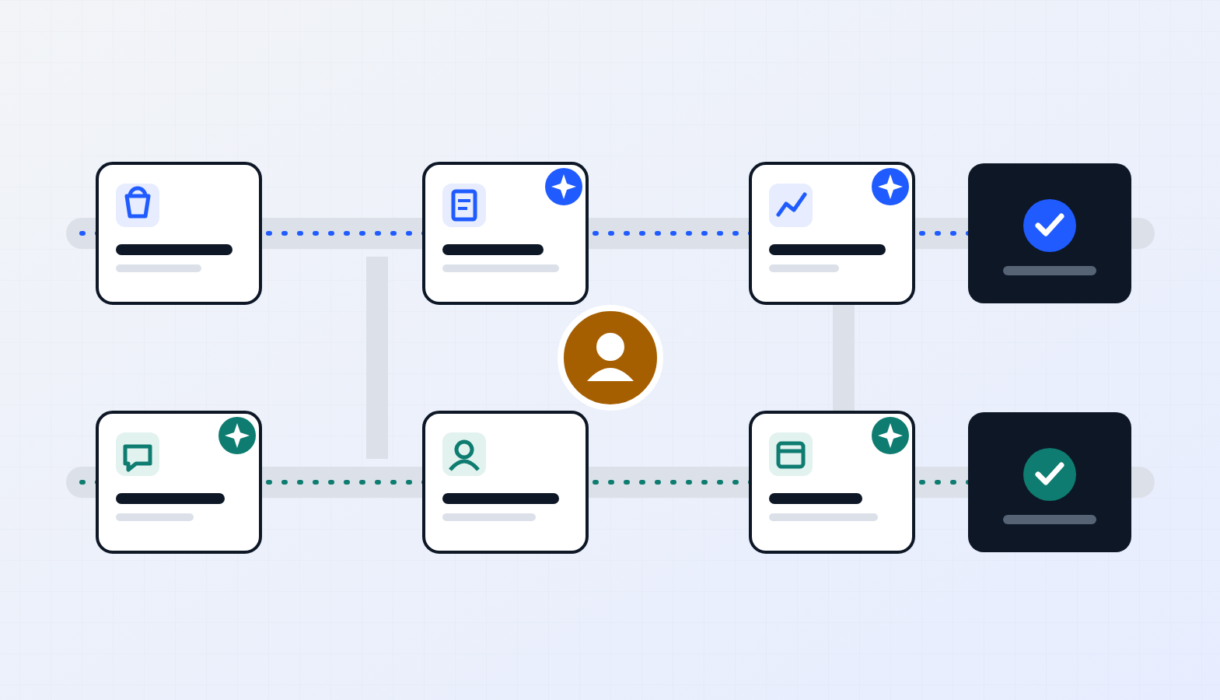
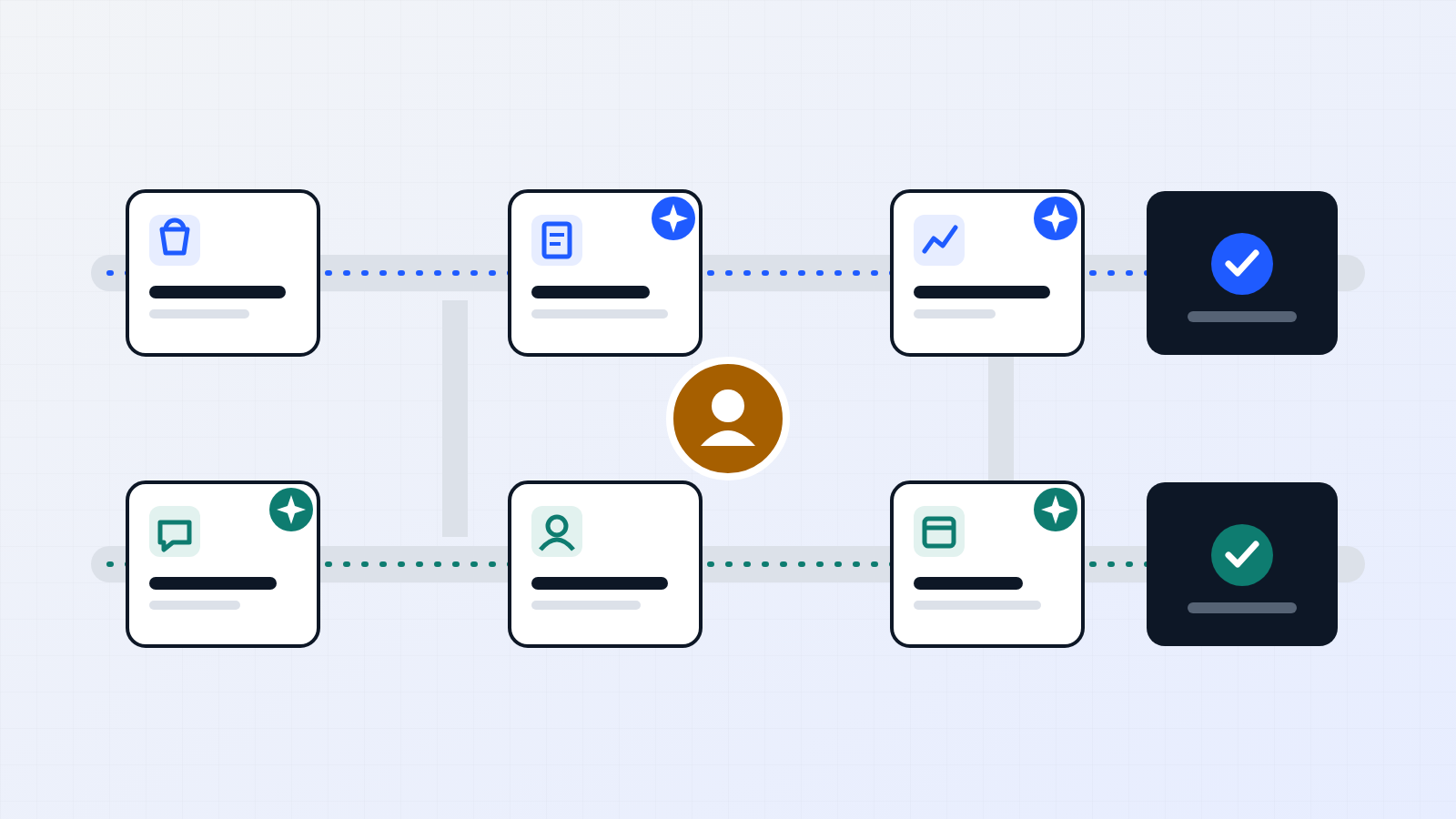
AI agents take a goal, carry out several steps across systems and hand the result — or the exceptions — to a person.
An embedded AI system is one that's part of how work flows through the business, not something people consciously open. An AI agent is software that can plan and complete multi-step tasks, such as reading an invoice, matching it to an order and flagging mismatches.
Wide use, shallow roots
McKinsey's 2025 global State of AI survey found that 88% of organisations regularly use AI in at least one business function, up from 78% a year earlier. But most are still experimenting or running pilots: only about one-third say they have begun to scale AI across the organisation [1].
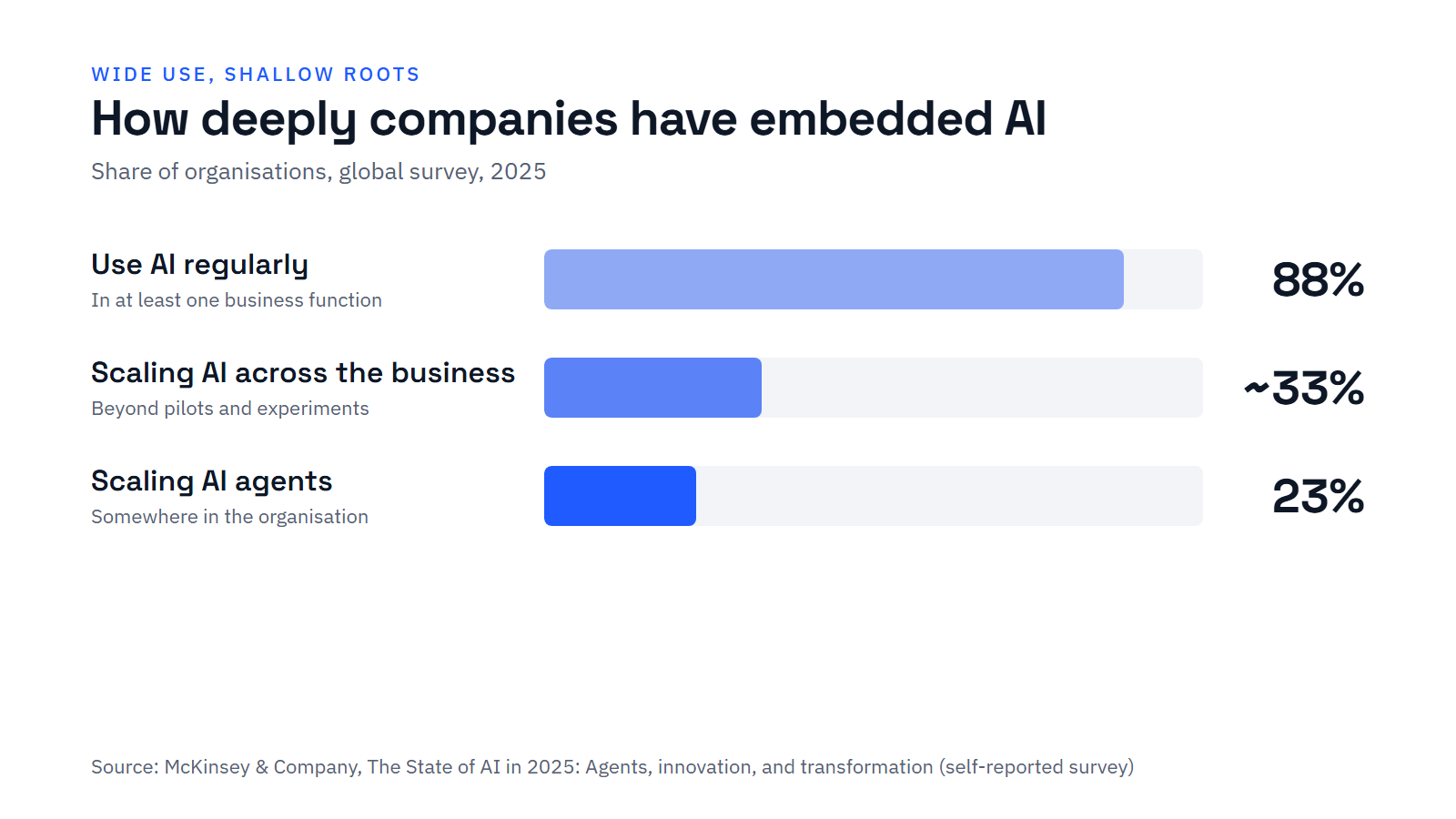
AI agents are earlier still. 23% of respondents said their organisations are scaling an agentic AI system somewhere, and another 39% are experimenting. Even among those scaling, most are doing so in only one or two functions — most often IT service desks and knowledge management [1].
What embedded AI looks like across the business
These are typical examples of how AI is being built into everyday processes:
Invoices and expenses
Reading invoices, matching them to purchase orders, coding expenses and flagging unusual payments for review.
Triage and replies
Sorting incoming requests, routing them to the right team, drafting replies and summarising long case histories.
Service desk
Resolving routine requests such as password resets and access requests, and passing harder problems to engineers.
Leads and content
Prioritising leads, updating CRM records after calls and drafting personalised emails and campaign copy.
Forecasting and supply
Predicting demand, suggesting reorder quantities and spotting delays in supplier deliveries.
People processes
Answering policy questions and drafting job adverts. Uses that affect hiring decisions carry higher legal risk and need close oversight.
Where it's heading
Analysts expect AI agents to spread quickly into the software businesses already use. Gartner predicts that by 2028:
33%
of enterprise software applications will include agentic AI, up from under 1% in 2024 [2]
15%
of day-to-day work decisions will be made autonomously by agentic AI [2]
40%+
of agentic AI projects will be cancelled by the end of 2027 [3]
That last figure is a reminder that ambition is running ahead of results. Gartner points to escalating costs, unclear business value and weak risk controls, and warns of "agent washing" — vendors relabelling existing chatbots and automation tools as AI agents [3].
Why embedding is harder than piloting
A pilot can succeed with a small team, clean sample data and plenty of attention. Embedding AI into a live process is a different challenge:
- Data. AI is only as good as the data it can reach. Messy, scattered or out-of-date records produce unreliable results.
- Integration. AI must connect to existing systems — and many older systems weren't built for it.
- Process redesign. Adding AI to a broken process usually just makes the broken process faster. The biggest gains come from rethinking the workflow.
- People. Staff need to trust the tool, know when to override it and understand how their role is changing.
- Measurement. Without clear before-and-after metrics, it's hard to prove value — or spot problems.
The hardest part of embedding AI is rarely the AI. It's the data, the process and the people around it.
Controls for when AI becomes invisible
The more seamlessly AI fits into everyday work, the easier it is to forget it's there — and the more important good controls become. Frameworks such as NIST's AI Risk Management Framework offer a free starting point [4]. Under the EU's AI Act, some uses — such as AI in recruitment or creditworthiness assessments — are classed as high-risk and carry specific obligations [5].
- Keep an inventory. Know which processes use AI, which vendors supply it and what data it touches.
- Name an owner. Every AI-assisted process needs a person accountable for its results.
- Set human checkpoints. Decisions affecting people's money, jobs, health or legal rights need human review.
- Monitor and log. Track errors, overrides and complaints, and keep records of what the AI did.
- Check suppliers. Ask vendors how their AI works, how it's tested and how your data is used.
What it means for workers
As AI takes on routine steps, many roles shift towards handling exceptions, checking outputs, improving processes and dealing with customers and colleagues directly. That can make work more interesting — but only if organisations invest in training and redesign roles deliberately, rather than simply adding AI and expecting people to cope.
What to watch next
- Agents moving beyond IT into finance, procurement and customer operations.
- Results versus hype — whether companies can show measurable returns from scaled AI.
- Software pricing as vendors charge for AI agents by task or outcome rather than by user.
- Regulation, including EU AI Act obligations for high-risk uses.
- Accountability — how organisations handle mistakes made by autonomous systems.
Sources
Every figure in this article comes from the sources below.
- McKinsey & Company (2025). The State of AI in 2025: Agents, innovation, and transformation. Global survey.
- Gartner (2024). Predictions on agentic AI: 33% of enterprise software applications to include agentic AI and 15% of day-to-day work decisions made autonomously by 2028.
- Gartner (June 2025). "Over 40% of agentic AI projects will be canceled by end of 2027." Press release, as reported by Outlook Business and others.
- National Institute of Standards and Technology (2023). Artificial Intelligence Risk Management Framework (AI RMF 1.0).
- Regulation (EU) 2024/1689 (Artificial Intelligence Act), Annex III (high-risk AI systems).